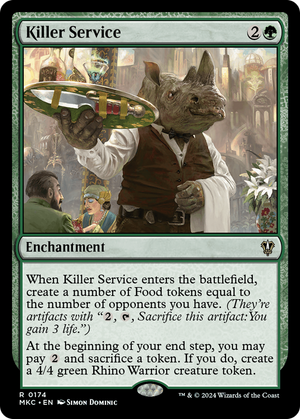
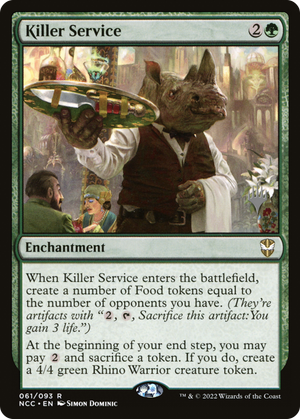
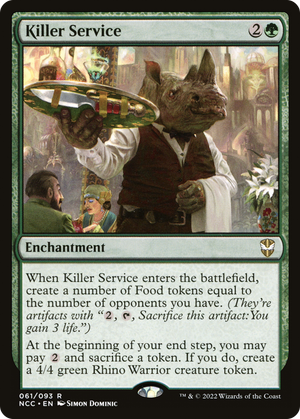
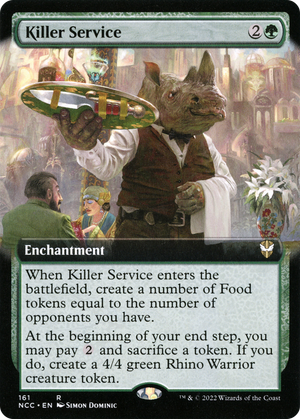
Killer Service


The scaling is the first thing to clock: the enters trigger keys the initial Food count off your opponent total, so what looks anemic against a single foe becomes a genuine token pile with three or four seats filled. But the enchantment's real work is the conversion loop it grafts onto that pile. Food is normally a lifegain valve, three points at a clip, and this adds a second exit each end step: pay a little, sacrifice a token, and mint a 4/4 Rhino Warrior. The token you feed the machine doesn't have to be Food, either. Any token qualifies: a spare Treasure, an unspent Clue, a leftover body from some other go-wide engine. That turns a closed lifegain loop into an open sink for whatever spare tokens a green deck stockpiles, which widens what it can slot into considerably. It patches a gap green knows well: the color grinds and clogs the ground but often lacks the burst to close, and laundering stored resources into recurring beaters supplies a finisher without demanding a separate payoff. The Food subtheme has mostly lived in lifegain and sacrifice-value shells; this reframes those tokens (and any others) as combat fuel, bridging an aristocrats-adjacent economy to a green army plan. The rate is deliberately unhurried, one Rhino per turn cycle, and the sacrifice fires after combat has resolved, so it rewards patience: an income stream that pays out in life or muscle depending on what the board demands.
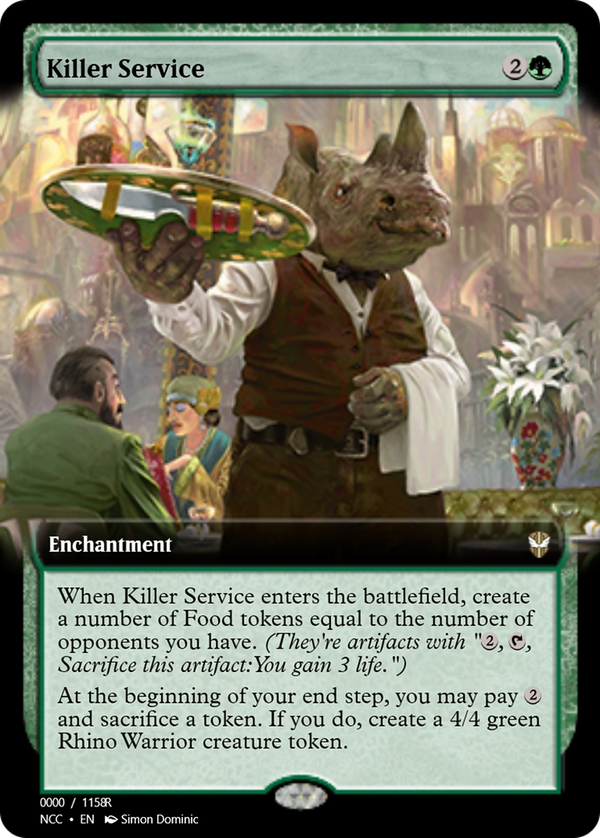
Rules text
,  , Sacrifice this token: You gain 3 life.")
At the beginning of your end step, you may pay and sacrifice a token. If you do, create a 4/4 green Rhino Warrior creature token.
, Sacrifice this token: You gain 3 life.")
At the beginning of your end step, you may pay and sacrifice a token. If you do, create a 4/4 green Rhino Warrior creature token.