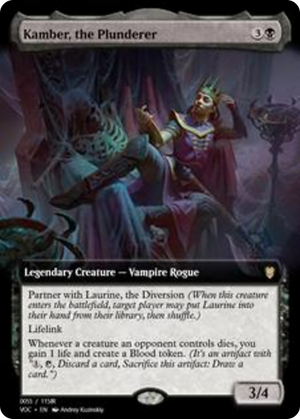
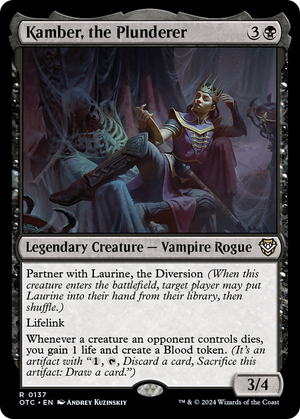
Kamber, the Plunderer


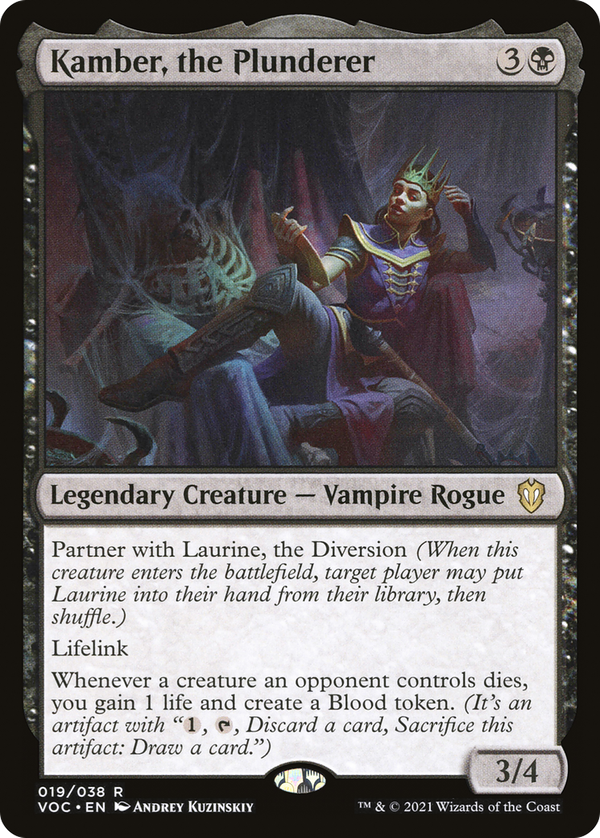
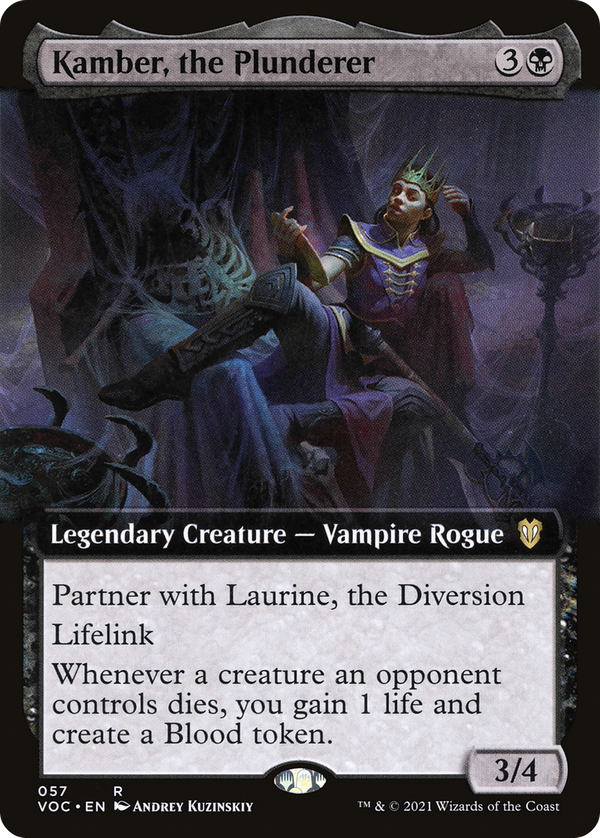
The whole engine here hinges on who does the dying, and it's not your creatures. Where most aristocrat payoffs reward you for feeding your own board into sacrifice outlets, this one flips the incentive outward: every opposing creature that dies drips a point of lifelink-adjacent gain and stamps out a Blood token, turning your removal spells and combat trades into a slow card-selection engine. That reframes what "board control" means when this is on the table. A wrath is no longer just a reset; it's a fistful of Blood tokens and a life swing. Edicts, deathtouch blockers, even the opponent's own sacrifice effects all feed you. The 3/4 lifelink body is almost incidental support for the trigger, a durable enough attacker to close a game the Blood tokens have already ground into shape. The Partner with Laurine, the Diversion clause quietly widens the strategy: Laurine wants creatures dying too, and pairing the two lets a deck commit fully to punishing the opponent's board without splitting its identity. What makes the design coherent is that the Blood token itself is a filter, not raw draw: you're trading cards to smooth toward the removal and threats that keep the death triggers coming, so the engine funds its own fuel. It's a payoff built for the grinder who would rather answer the opposing board a dozen times than build a single explosive turn.
Rules text
 ,
,  , Discard a card, Sacrifice this token: Draw a card.")