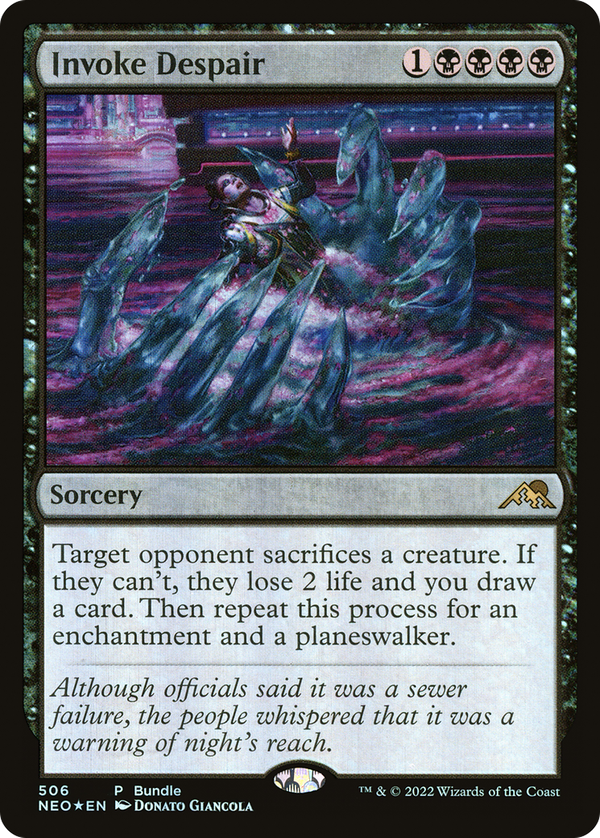
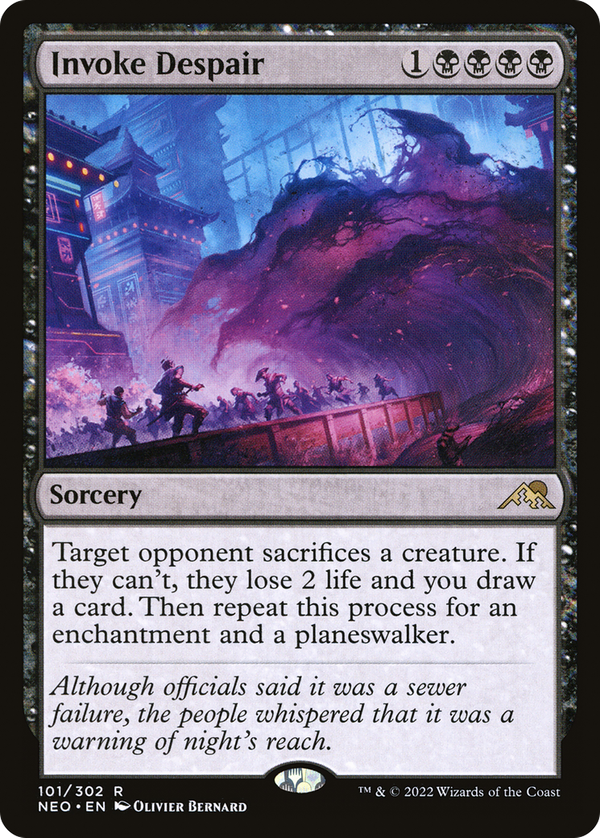
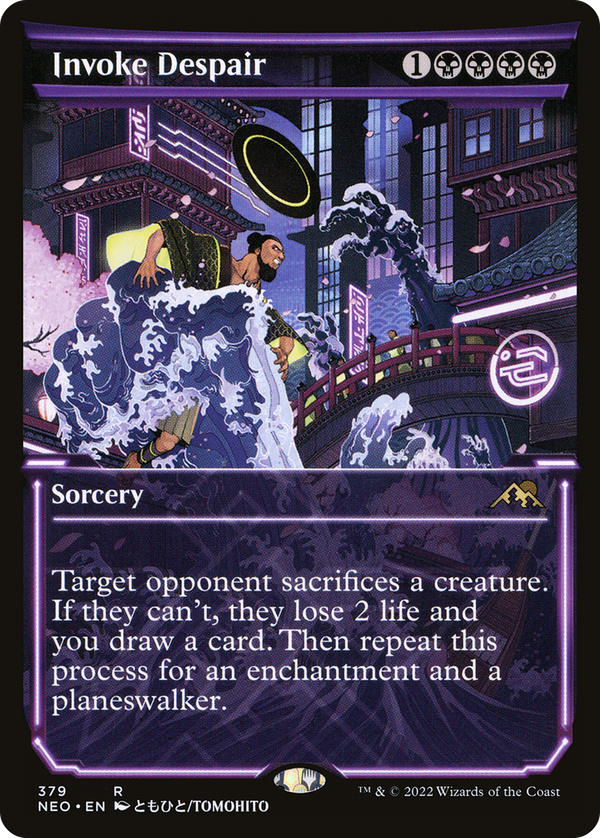
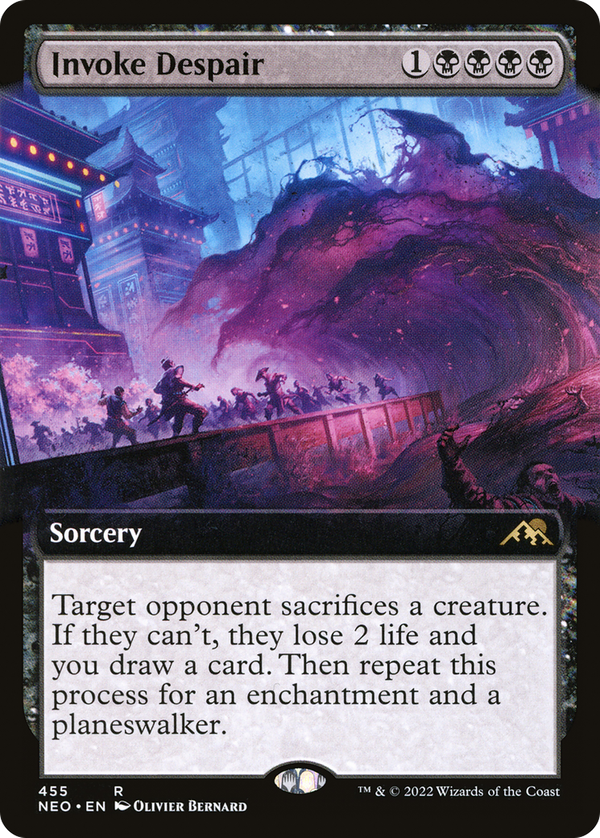
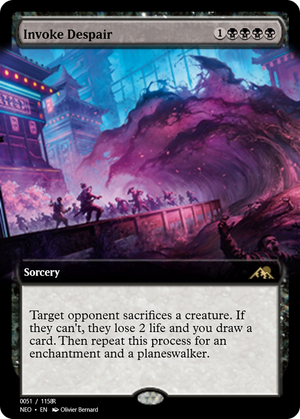
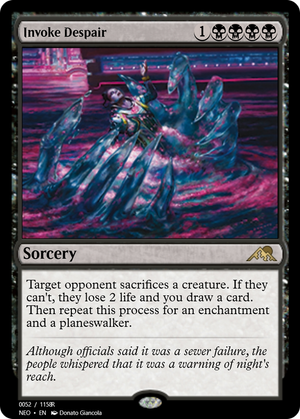
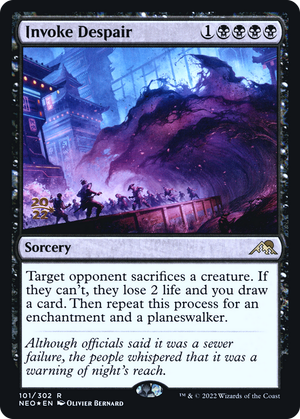
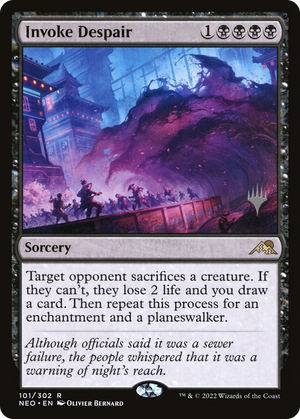
Invoke Despair


The four black pips are the whole thesis: a mono-black investment that pays out in mono-black terms. Every clause has a built-in floor. If the opponent controls the permanent, they sacrifice one of their choice; if they can't, they lose two life and you draw. There is no dead line, no matchup where the spell fizzles because the board is wrong. Against a creature deck the first clause functions as an edict; against a shell that happens to control none of the three permanent types, every whiff pays you back in life loss and cards. That symmetry between stripping a permanent and being compensated for the miss is what lets a five-mana sorcery survive in a world of tempo-positive interaction. Crucially, it never targets the permanents at all: the opponent chooses what dies, which places it in the edict lineage (Diabolic Edict, Chainer's Edict) rather than the pointed-removal lineage, and that distinction is what slips it past hexproof and protection. The design lesson is subtle. Rather than pushing raw power, it engineers out the downside variance that usually keeps a swiss-army answer out of serious decks: you are never sorry to draw it, and across creatures, enchantments, and planeswalkers there is rarely a board where all three riders come up empty. That consistency is worth more than a flashier ceiling.