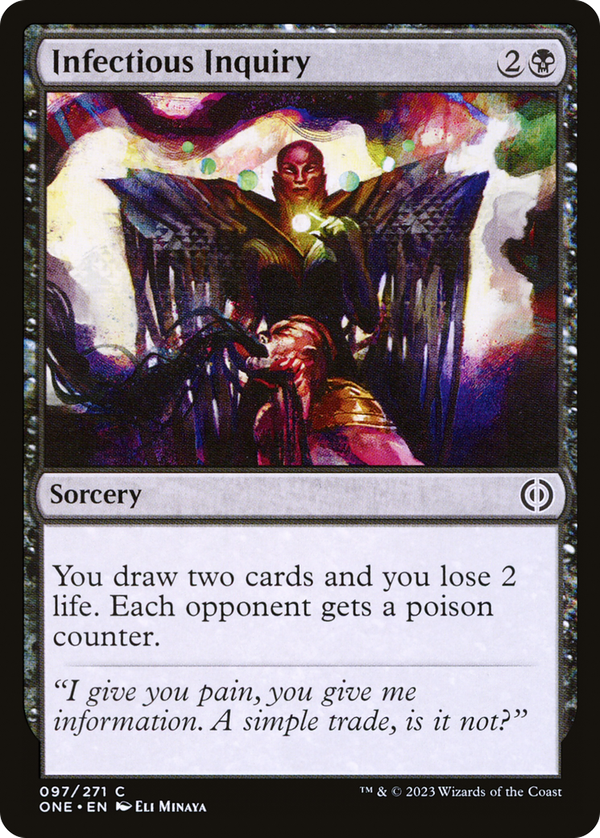
Infectious Inquiry


Sign in Blood grafted onto a poison strategy: draw two, pay the life, and each opponent picks up a poison counter for the trouble. The card-draw half is a known quantity, priced at the familiar rate of two life for two cards, but the third clause is what turns this from a filler cantrip into a payoff. That poison counter lands on every opponent for free, no attack required, which matters enormously in a plan that wins by getting an opponent to ten counters rather than to zero life. In a poison shell the counter is not incidental value tacked onto a draw spell; it is a second wincon axis advancing every time you refill your hand, and a body of proliferate effects that suddenly has one more thing to grow. The tension the design resolves is the one every infect-adjacent deck runs into: drawing gas usually means not developing your clock. Here the two are the same action. The life loss is the honest cost, and when your own life total is already a resource you spend freely, paying two to dig for the pieces that finish a poison kill is a trade you make gladly. Strip out the counters-matter payoffs and it collapses back into an overcosted spell you would rather cast as Sign in Blood; the poison line goes dead, and the card knows it.