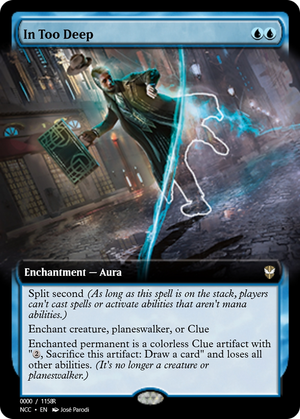
In Too Deep

Blue does not really have removal, so it improvises: it borrows from the Polymorphist's Jest tradition of not killing a threat but redefining it. This welds that idea to split second, which is the piece that makes the answer airtight. The window between casting and resolution is exactly where creature-based decks defend themselves: a sacrifice outlet, a protection spell, a flicker to reset the Aura. Split second slams that window shut on nearly all responses, so the enchanted creature or planeswalker can barely be responded off in reply, and the target never yields a death trigger because it never dies. It simply becomes a Clue, a pointed indignity: the opponent keeps a permanent, but it is now a two-mana cantrip they mostly do not want to crack. The "Enchant Clue" clause looks like flavor but is doing load-bearing rules work. An Aura that changes its host's type has to legally be able to enchant that new type, or state-based actions pull it off the moment the transformation happens; naming Clue is what lets the Aura stay attached to the artifact it just created. What makes this remarkable is the pricing: unconditional, uninteractive answers are supposed to cost real mana or real cards, and this pays the whole bill in color intensity and the split-second lock rather than in rate. That is a rare gift to a color that historically has to work much harder to make a threat go away.
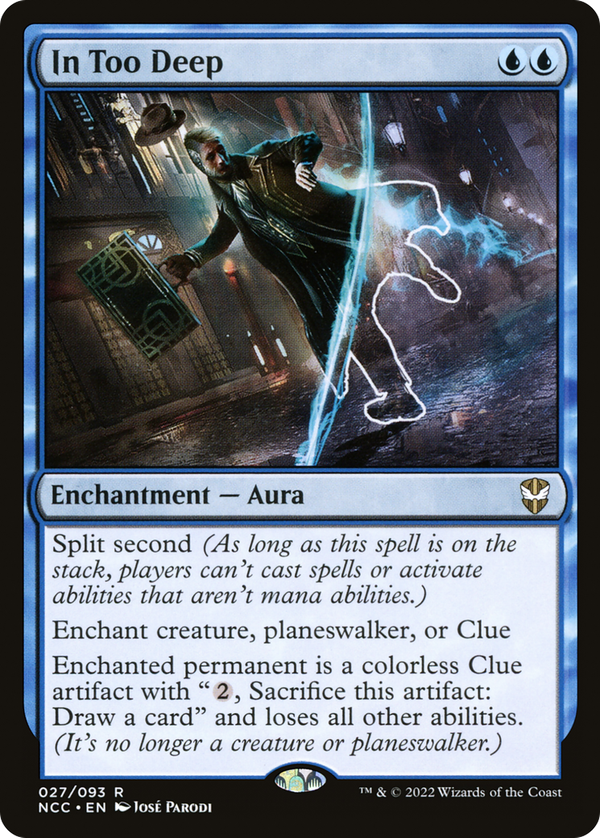
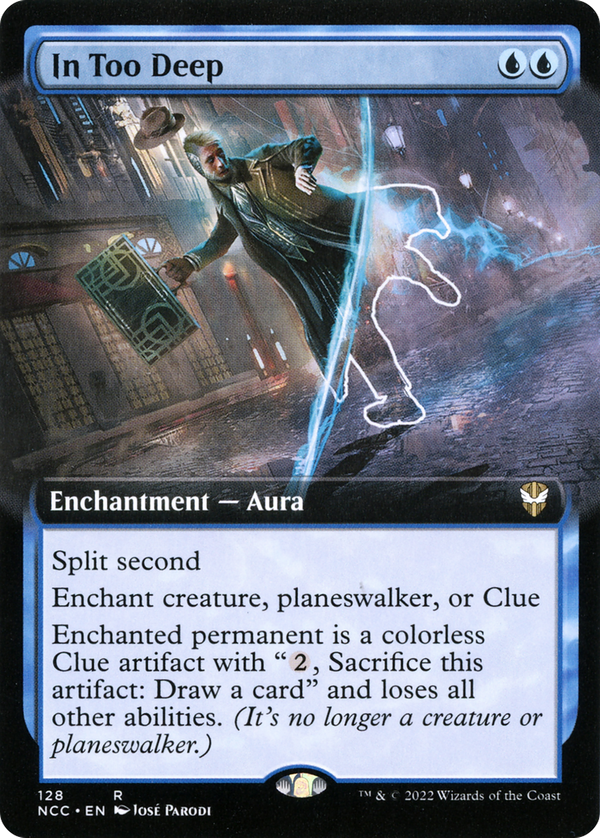
Rules text
 , Sacrifice this artifact: Draw a card" and loses all other abilities. (It's no longer a creature or planeswalker.)