Huddle Up


The Assist keyword only ever meant something in multiplayer formats, and this is the cycle's cleanest demonstration of why. On its own the effect is a two-card Divination scattered across the table: two target players each draw, and neither of them has to be the caster. Aimed at anyone but yourself, the caster spends the full cost to hand strangers cards and keeps nothing, which is deliberately terrible solitaire. Assist is the lever that fixes it: a neighbor can cover up to two of the mana, shrinking the caster's contribution toward a single blue while the helper foots the rest and shares in the draw. The design reframes a draw spell as a negotiation. The mechanical wrinkle sits in the casting sequence itself: contributions land while the spell is already on the stack, during the step where its total cost is determined and paid, so the helping player commits mana to a spell they do not control and cannot redirect once it resolves. It is multiplayer politics encoded into the cost line rather than the effect: who you aim the cards at and who agrees to pay are two separate conversations happening at once, and they need not involve the same person. As team-play design it is honest about its own limits, a card that admits it is mediocre alone and only earns its rate when the table is built to share.
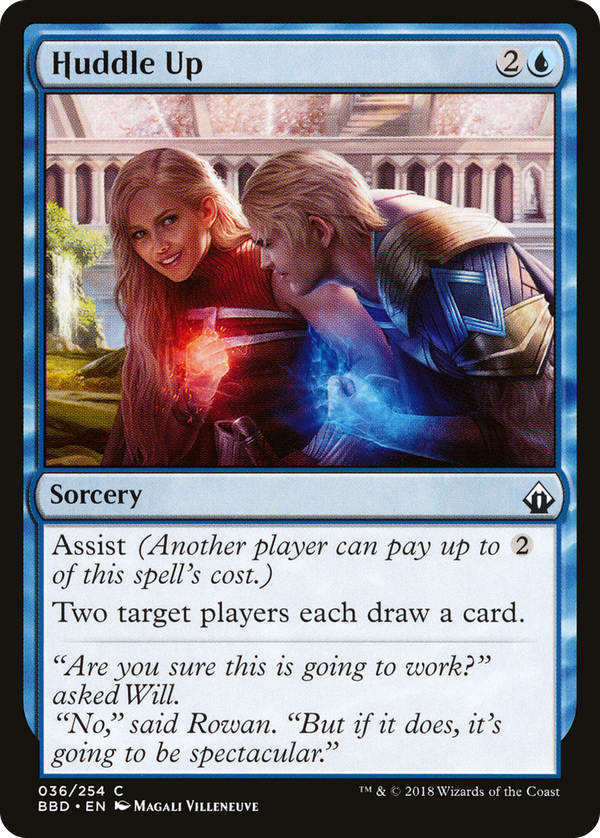
Rules text
of this spell's cost.)
Two target players each draw a card.