Hour of Revelation


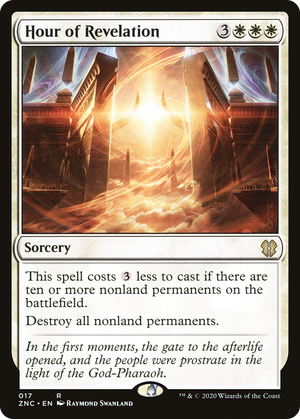
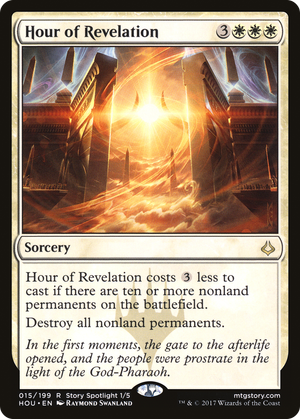
The clever wrinkle is that the board state pays for the wrath. White's symmetrical sweepers have always been priced as a deliberate tempo sacrifice: you spend your turn unwinding everyone's development, and the four or five mana you pay buys the reset. Here the cost moves inversely to how badly you need the effect. On an empty or sparse board the sorcery sits at its full six, which is exactly when you don't want to be casting it. Let the table sprawl to ten nonland permanents and it collapses to triple white, a three-mana board wipe that hits creatures, planeswalkers, artifacts, and enchantments alike. That reduction is not a trigger you wait on; it is a static cost modification checked as you cast, applying only while the condition is already true, so the card reads as a relief valve for the player drowning in a developed board rather than a proactive tempo play. The triple-white pip in the reduced cost is the constraint doing the balancing: this is a payoff for a heavily white commitment, not a splash. Where a creatures-only wrath leaves walkers and the enchantment that's about to win standing, this answers the whole permanent layer in one cast, making white's late-game catch-up the explicit selling point rather than a side effect.
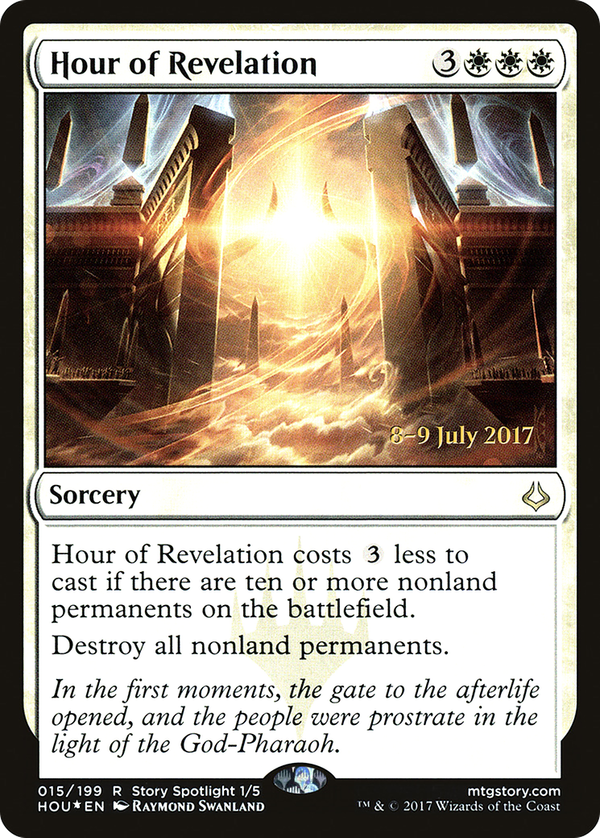
Rules text
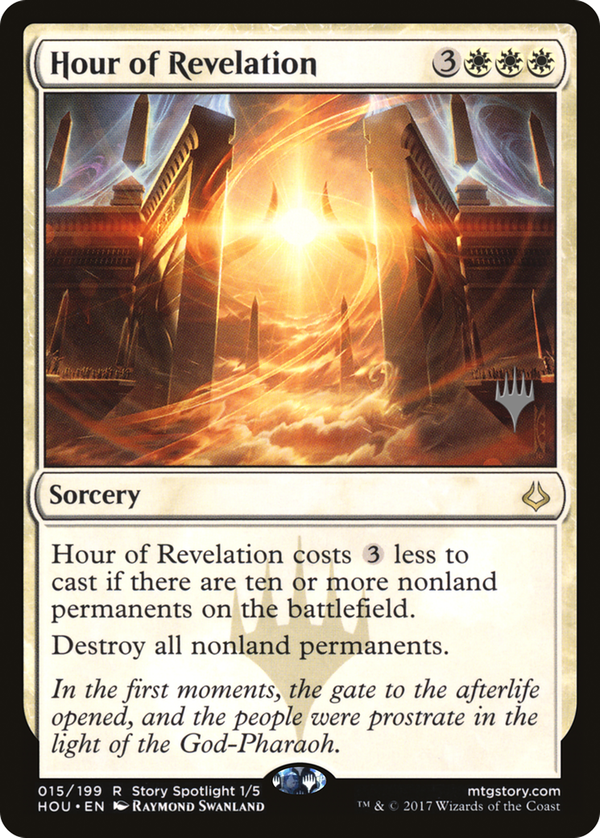
less to cast if there are ten or more nonland permanents on the battlefield.
Destroy all nonland permanents.