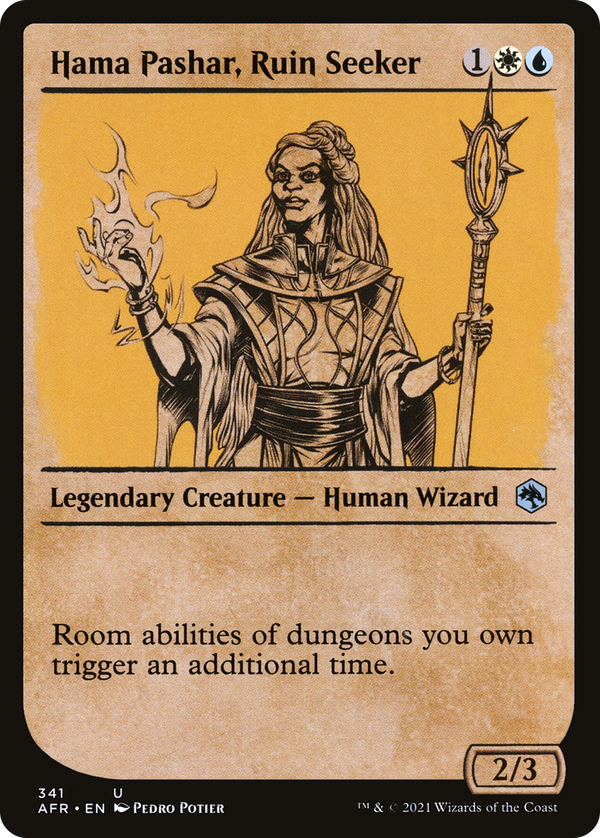
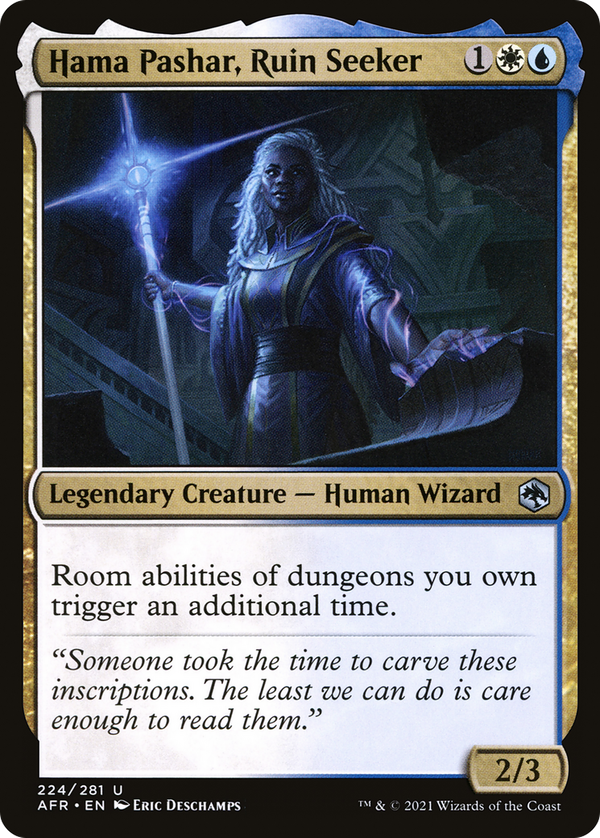
Hama Pashar, Ruin Seeker



Dungeons were a strange thing to hand a doubling engine, because a dungeon is not a permanent or a resource pile: it is a track you walk one room at a time, and each room fires as you enter it. This body reads that track and makes every room resolve twice, which quietly changes what the dungeon is for. A single venture becomes a double-dip, and the deepest room of each dungeon (the payoff that normally caps a long march) resolves twice into a burst the rest of the game was building toward. The catch is that the reward is only real if you are already venturing repeatedly, since individual room triggers are small on their own, and a deck built to venture often is a narrow proposition outside the pool that supports it. What makes the creature more than a niche multiplier is that it does not touch a resource anyone else in the game manipulates. There is no interaction with counters, tokens, or triggers broadly; it reaches into a private mechanic that only the venturing player owns, which is why it lives or dies entirely on how many dungeon rooms you can afford to enter. A three-mana legend that hits the table early, it is the enabler that makes the venture mechanic look like a plan rather than a bonus.