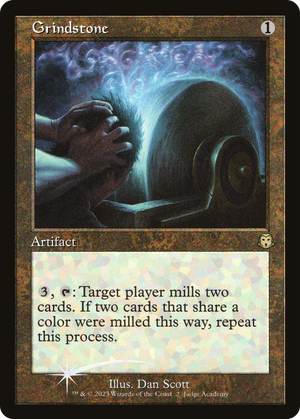
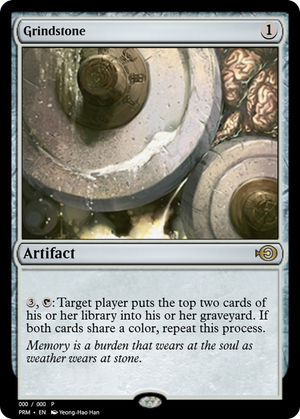
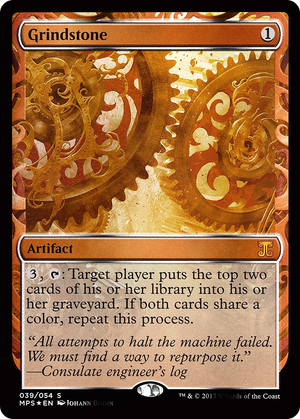
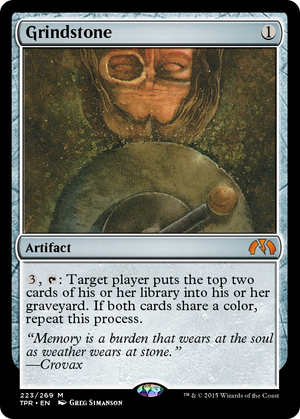
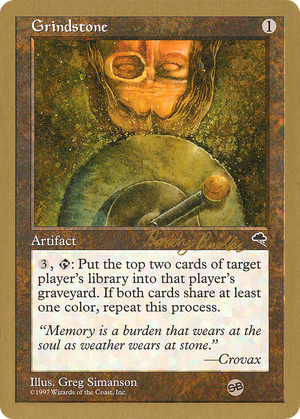
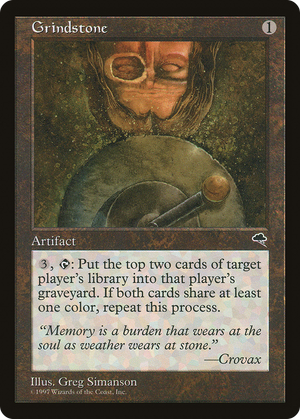
Grindstone

The mill ability that nobody much cared about for years, until somebody noticed that "share a color" is a condition you can guarantee. On its own, this grinds two cards at a time and stops the moment it mills a pair that shares no color: two cards of different colors, or any card with no color at all, such as a land or a colorless artifact. In the average sixty-card deck the loop breaks within a cycle or two, which makes it a slow, unreliable library-eater and a curiosity built around an iteration clause the target's own library defeats by accident. The trick is to erase color diversity from the equation. Pair it with an effect that turns every card in the opponent's library into a single color (Painter's Servant, naming a color, is the canonical partner), and the repeat condition stops being a coin flip and becomes a certainty: every pair milled shares that color, so the loop never terminates until the entire library is gone. The whole deck mills out in one activation. That is the design lesson hiding in the rate. A repeat-until-fail engine is only as safe as its termination clause is hard to satisfy, and this one outsources its safety valve to the color makeup of the target's library, a property the opponent does not control and a combo player can overwrite wholesale. The repeat checks colors, not card types, so a single color-setting permanent collapses the stop condition to nothing.
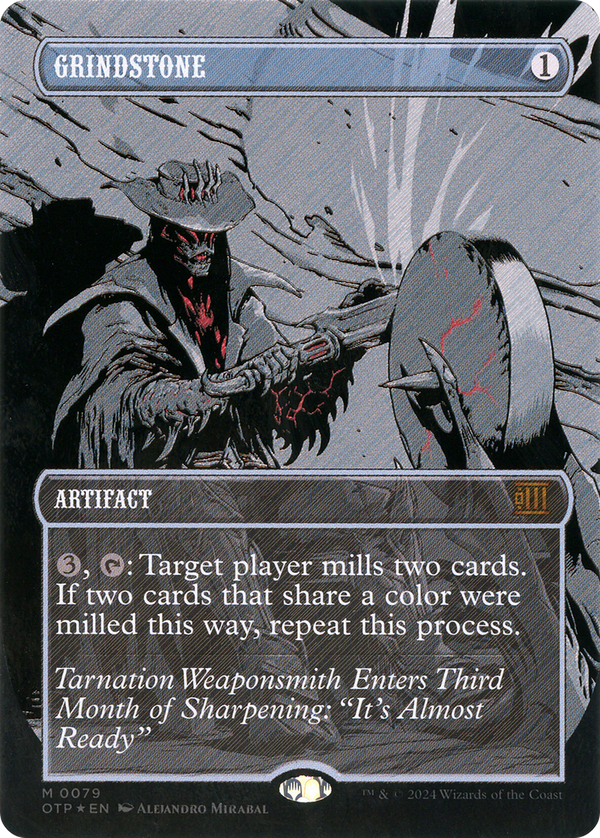
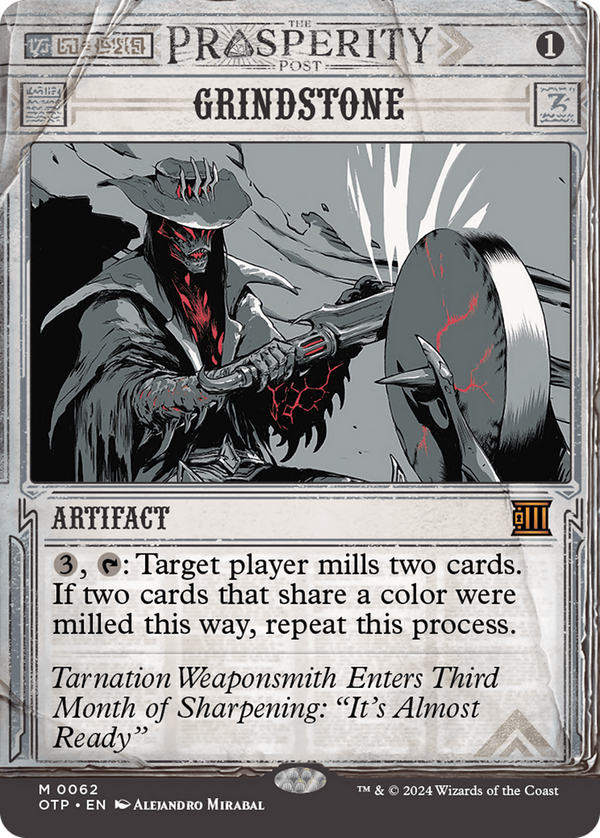
Rules text
 ,
,  : Target player mills two cards. If two cards that share a color were milled this way, repeat this process.