Ghyrson Starn, Kelermorph



The whole design rests on a number most cards treat as a rounding error: exactly 1. Any source you control that pings a target for a single point of damage triggers a 2-damage follow-up, turning pingers, snipers, and incidental one-damage effects into three-point removal engines. That "exactly 1" clause is deliberately fragile: overshoot to 2 and nothing fires, so the deckbuilding pull is toward precision instruments rather than raw burn. It rewards the kind of one-damage tools that have always been ceiling-limited (Prodigal Sorcerer and its descendants, the many effects that deal a single point on entry or attack) and hands each of them a second, larger arrow the moment they connect. The stack behavior matters too: the triggered damage checks who or what took the initial hit and follows it there, so several sources firing in a turn can be sequenced into board-wide chip damage across multiple triggers. Ward taxes the cheap removal that would otherwise pick off a fragile 3/2 body, and the symmetry is pointed: the very effects it exists to punish are the ones most likely to answer it, so the tax shields the engine from its own weakness. Outside a shell of low-damage sources it is a taxed body with an idle trigger; inside one it converts the least efficient damage in the game into the most.
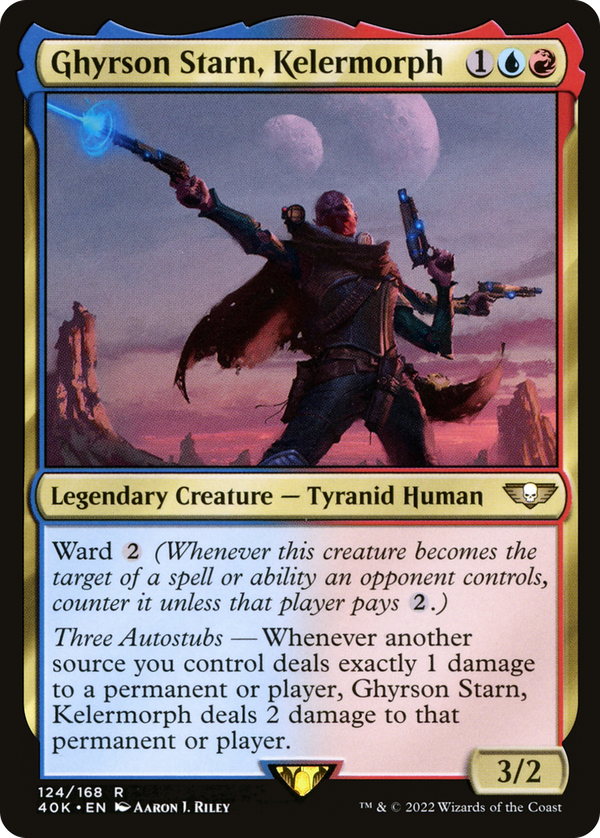
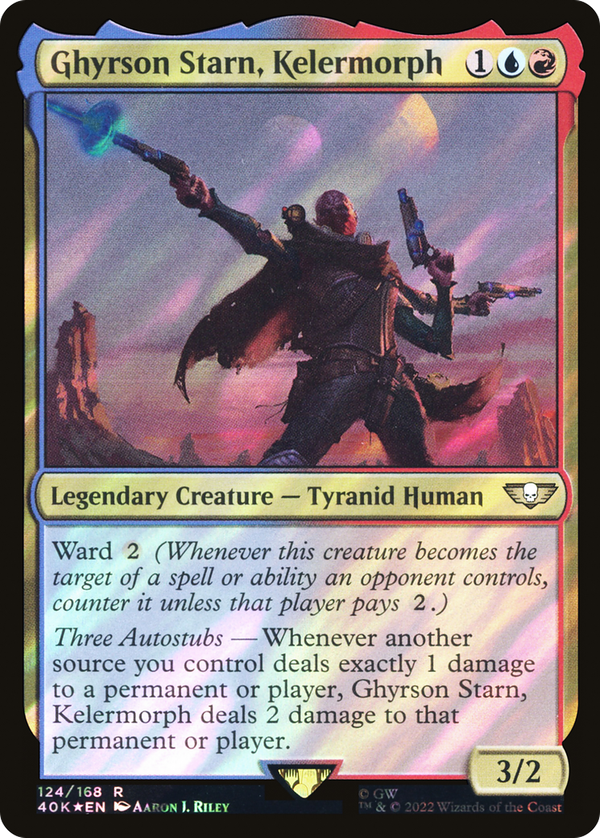
Rules text
 (Whenever this creature becomes the target of a spell or ability an opponent controls, counter it unless that player pays .)
Three Autostubs — Whenever another source you control deals exactly 1 damage to a permanent or player, Ghyrson Starn deals 2 damage to that permanent or player.
(Whenever this creature becomes the target of a spell or ability an opponent controls, counter it unless that player pays .)
Three Autostubs — Whenever another source you control deals exactly 1 damage to a permanent or player, Ghyrson Starn deals 2 damage to that permanent or player.