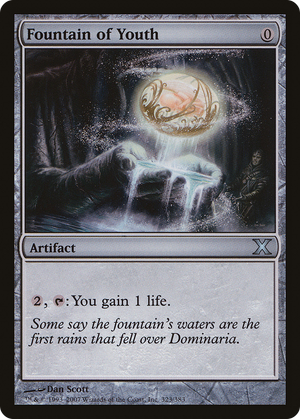
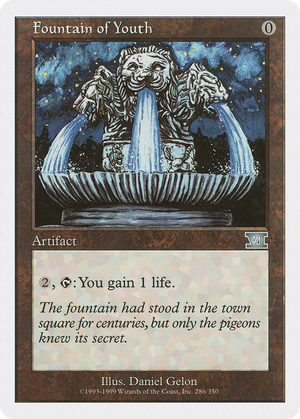
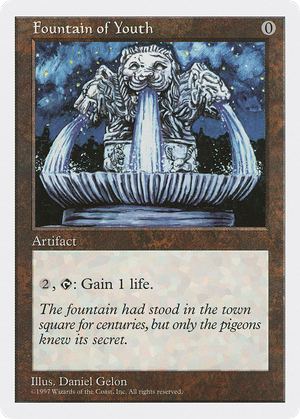
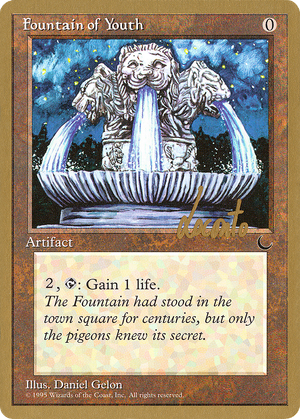
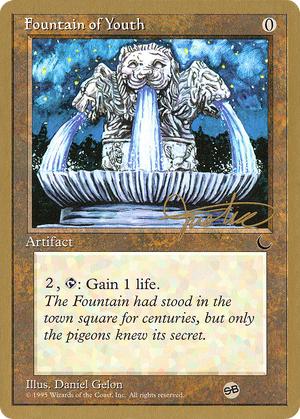
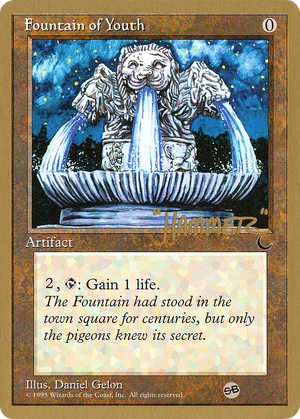
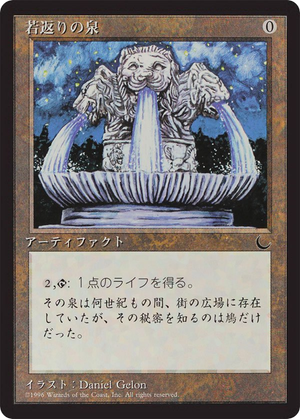
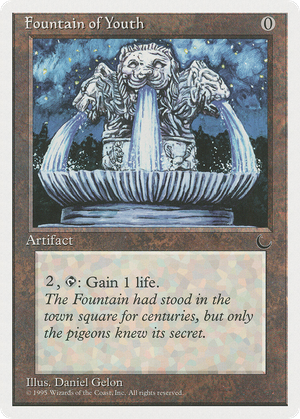
Fountain of Youth

Pay two mana, tap, gain one life, repeat: at that exchange rate, the rope back to a winning position is so long it never reaches. Early design treated lifegain as an inherently good thing to be metered out carefully, hence the deliberately punitive activation; the assumption was that incremental life mattered enough to warrant a real mana commitment. What the years revealed instead is that a life point bought at two mana is a life point you will almost never want, because the decks that need lifegain need it in bulk and at a discount, and the decks that can afford to spend mana this slowly are not the ones racing a clock. It survives as a footnote in combo loops where any repeatable lifegain effect, however inefficient, becomes a free engine piece once the mana cost is zeroed out or the loop is otherwise free. Outside those edge cases it stands as a monument to a kind of card Magic stopped printing once it learned what life total actually costs: priced by flavor weight rather than board impact, the sort of artifact that explains, by contrast, why later utility artifacts cost so little.
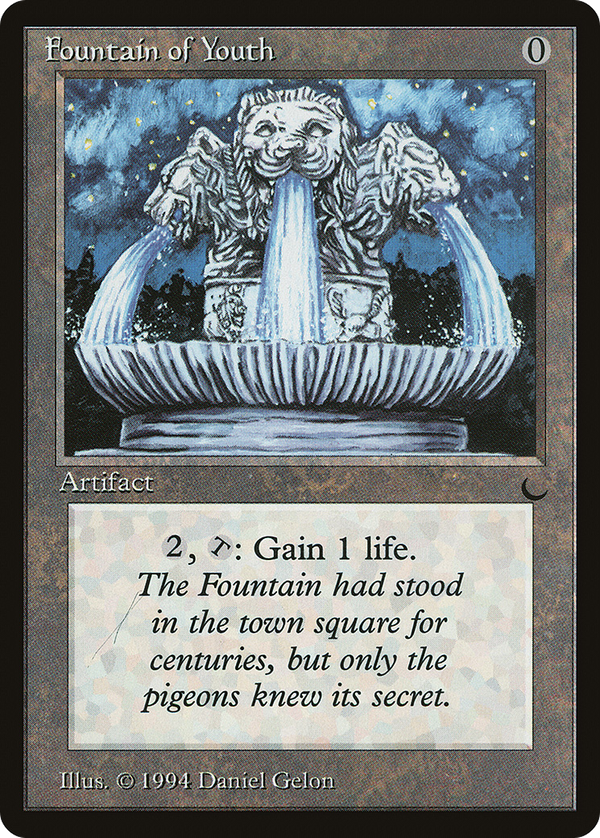
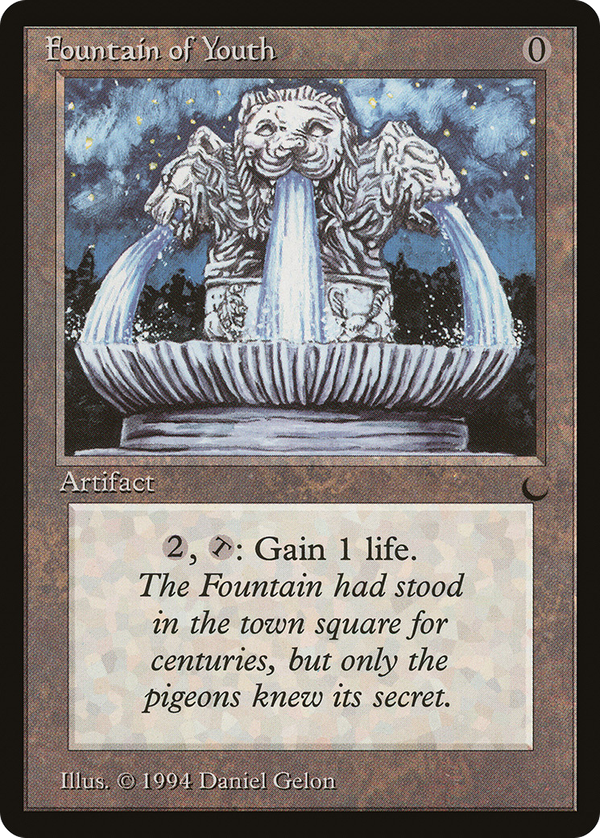
Rules text
 ,
,  : You gain 1 life.