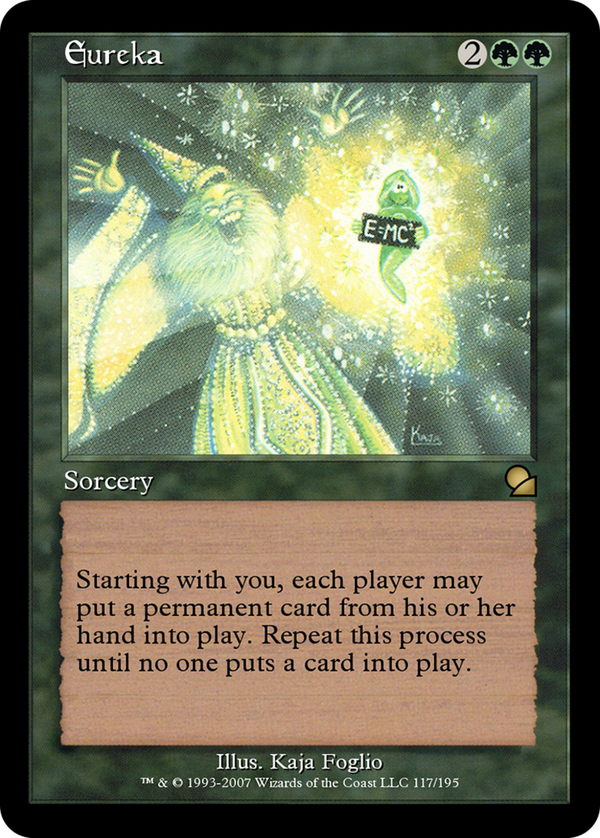
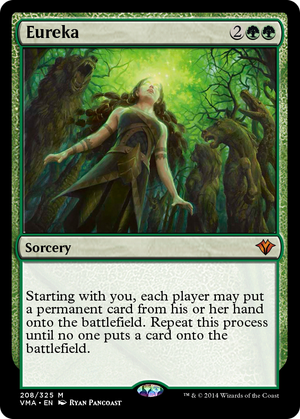
Eureka


Richard Garfield's pre-Sliver Queen experiment in symmetric explosion. The design premise is that "fair" can be defined by simultaneity: players take turns putting permanents onto the battlefield until everyone stops, so the spell costs four mana and reads as a wash on the surface. But the player who builds around it never treats it as symmetric. A reanimator-style hand that lands a Sundering Titan or an Emrakul, the Aeons Torn against an opponent's two-mana rock has already won the exchange before the loop resolves, and the starting-with-you clause lets the caster set the floor on the first pass. The card is also a structural ancestor of the cheat-into-play archetype: Show and Tell is the same idea narrowed to one permanent each, with the symmetry tightened because Garfield's open-ended version proved too easy to break. Sneak Attack, Hypergenesis, and the various Omniscience shells all inherit the same operating principle, which is that mana cost is the wrong axis to balance a spell that puts permanents directly onto the battlefield; the right axis is what the opponent gets to do with their half of the deal. Eureka set that lesson, and every cheat effect since has been a more disciplined version of the same conversation.