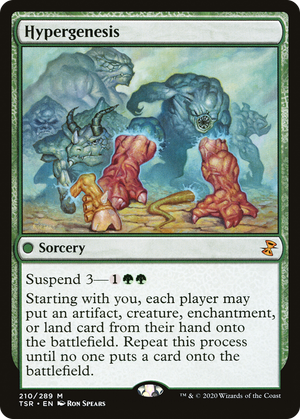
Hypergenesis
Printed mana value zero, but the card is functionally uncastable for that zero: with no mana cost, you cannot pay nothing and play it, so the only legal routes are suspend (pay 
 , wait three turns) or an alternative cost that ignores the unpayable cost entirely. That second route is the whole story. Cascade does not care that the cost is blank; it casts the spell for free off the top of a deck, which is how Hypergenesis went from a slow telegraphed payoff to an instant-speed concession. Suspend was conceived to delay powerful effects in exchange for advance warning; cheating the cast sidesteps both halves of that bargain. The symmetry clause looks fair until you notice who built around it: the caster has loaded their hand with Emrakul, the Aeons Torn and Worldspine Wurm to win the put-permanents-down war, while a fair opponent has nothing comparable to drop in response. That is the asymmetry the design never accounts for, and it is why the format that hosted the Cascade build removed the card from its legal pool rather than tolerate a turn-one-or-two dump of the most expensive creatures in the game. The lesson it left behind is about cards whose printed cost is zero: the real cost lives in the access method, and once a free way in exists, the suspend timer that was supposed to balance the effect becomes irrelevant.
Rules text
Starting with you, each player may put an artifact, creature, enchantment, or land card from their hand onto the battlefield. Repeat this process until no one puts a card onto the battlefield.