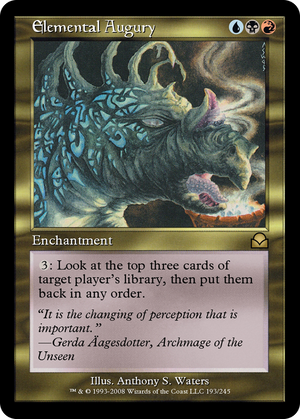
Elemental Augury



Pay three mana, peek at the top three cards of any library, and stack them however you like: that is the entire engine, repeated as often as you can afford it. In 1995, knowing your next three draws genuinely was power, and Wizards gated this purely Grixis-colored effect behind all three of its colors plus a recurring mana sink. The targeting is the genuinely strange wrinkle. It reads an opponent's library as easily as your own, framing the card as an information weapon: bury a foe's draws in the worst possible order, or fix your own sequence. The cost structure tells you what kind of card this is. It never touches your hand or board and never removes anything from a deck; it only reorders cards that stay exactly where they were, just in an arrangement you chose. So this is a control tool with no closing power, a knowledge engine that assumes games run long enough for incremental peeking to compound into an edge. What dates it is everything that came after: scry, surveil, and impulse draw all do this work while also advancing your turn, leaving an effect that merely rearranges with nothing to show for the mana. This is library control attempted before the vocabulary for it existed, an arcane-feeling enchantment from a time when seeing the future was treated as worth a triple-color premium.
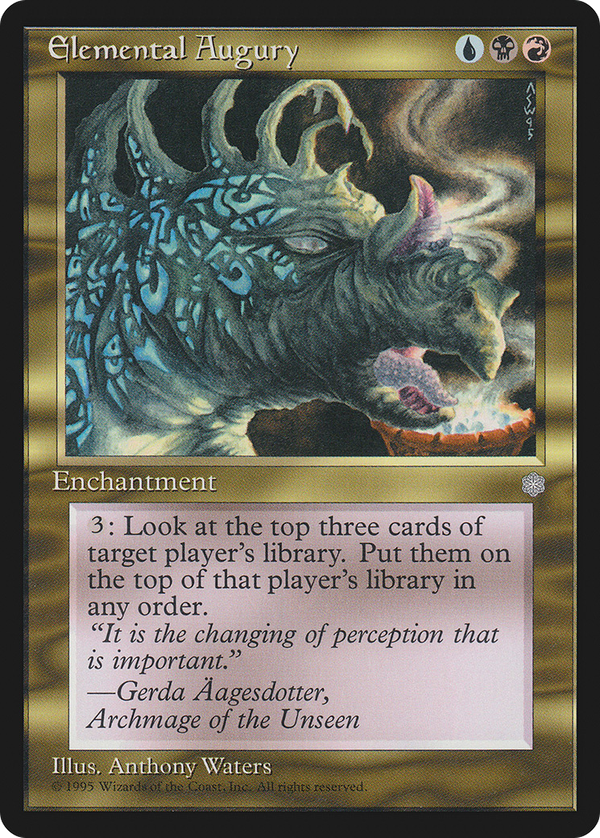
Rules text
 : Look at the top three cards of target player's library, then put them back in any order.