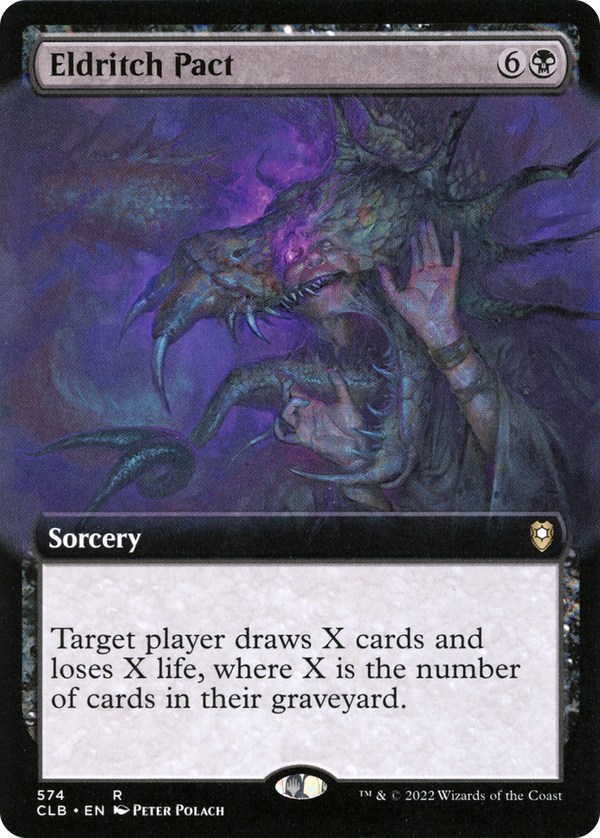
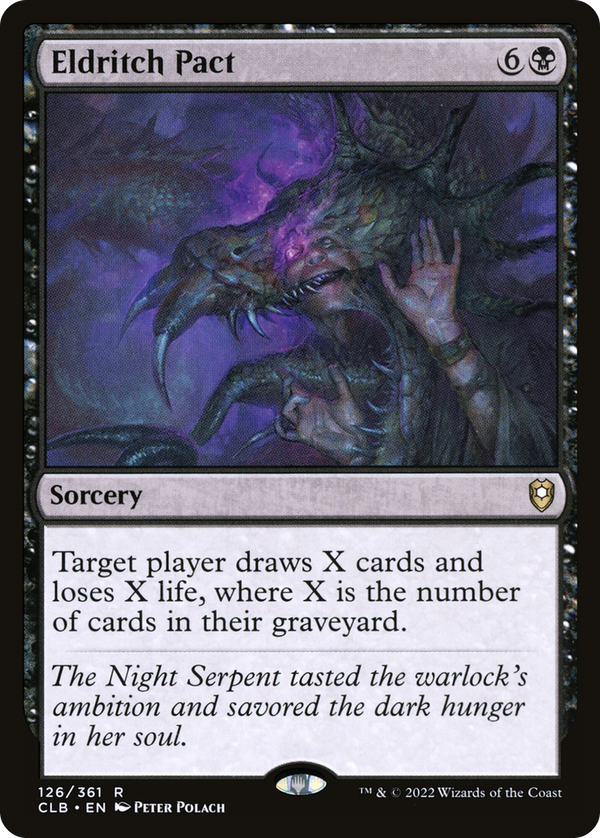
Eldritch Pact


The payout scales to whatever the target has already buried, which means the caster picks whose graveyard sets the price. Aim it inward and it becomes a refill engine: self-mill, cheap cantrips, and cycling all convert a stocked graveyard into a fresh hand, with the life loss reading as a rider on a resource you filled on purpose. Aim it outward and the same math flips into a weapon that reads an opponent's pile instead of yours. A mill deck's graveyard, a reanimator's stack, a control player who has already flashed back half a spellbook: each becomes a hand you force into their grip and a chunk of life you force them to pay, both landing on the chosen player rather than the table. That directional choice is what separates it from an ordinary black draw spell that only ever refuels its own controller; here the count that determines X can belong to anyone. Seven mana sets a high floor: this is a card you cast once the graveyard math has already tilted in your favor, and pointing it at a truly full graveyard is a wager on whether the target survives drawing that deep. It sits squarely in black's oldest bargain, cards paid for in life, but the graveyard-count wrinkle turns a symmetric-looking effect into a directed, political instrument.