Dream Twist

Six cards of mill for two casts of one card: that arithmetic is the entire reason a self-mill graveyard deck ever looked at this. Three cards now, three more from the graveyard later for two mana, all at instant speed, which means it doubles as a single card that does the work of two without occupying two slots in the deck. The flashback clause is the part that matters for the strategy it serves: a mill-yourself plan needs cards that fill the bin efficiently and then keep filling it, and a spell that mills you a second time from inside that bin is a self-completing loop in miniature. As a piece of straight library destruction aimed at an opponent, three is too slow to matter; the card's home was never the attrition mill plan but the self-targeting engines that want their own cards dead and counted. That distinction (mill as a resource you spend on yourself, not a clock you run on someone else) is what the design is built around, and it is why the card sits comfortably in graveyard-fueled strategies and nowhere else. The instant speed is mostly a convenience for holding mana, but it does let the second cast slot into an end step without giving up a turn's tempo.
Rules text
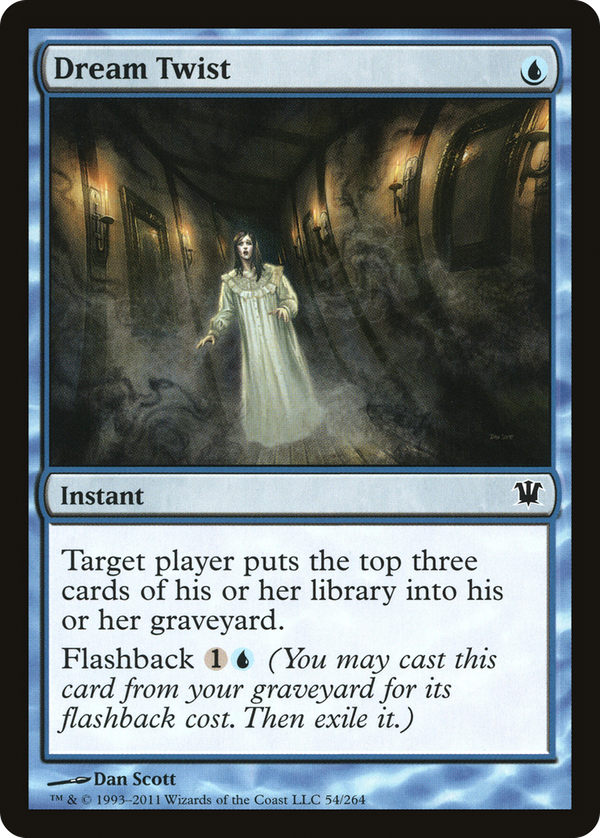
 (You may cast this card from your graveyard for its flashback cost. Then exile it.)