Death's Oasis



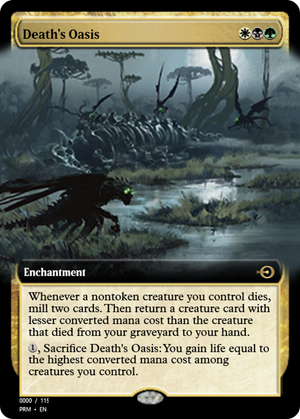
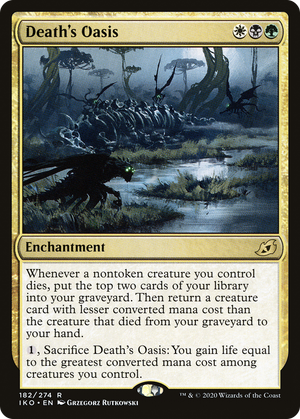
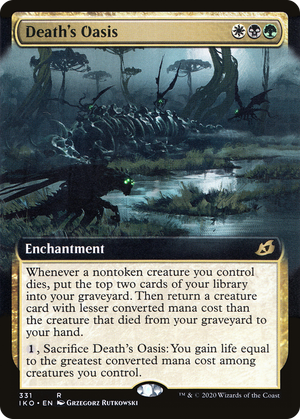
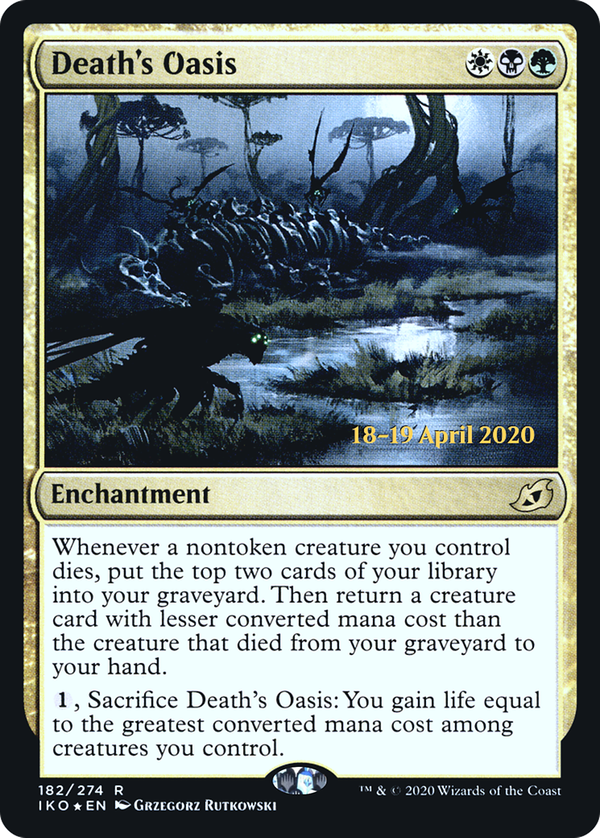
The recursion clause is built to spin downward, not up: whenever a nontoken creature you control dies, you mill two and hand back a creature strictly cheaper than the one that just left. That nontoken restriction and the word "lesser" together keep a Wedge sacrifice engine from becoming a perpetual-motion machine. Token fodder does not feed it, and you cannot loop the same creature into itself; you climb down your curve, trading a four-drop's death for a three-drop's return, then a two, then a one, until the chain bottoms out or you refuel. The design rewards a spread of real card costs rather than a pile of identical bodies, a subtler deckbuilding ask than most graveyard payoffs make. The mill-two rider is not incidental either: it feeds itself, digging toward the next recursion target while stocking a yard for whatever else wants it. Then there is the exit door, a sacrifice-outlet clause that converts your biggest creature's mana value into a lump of life, turning a stalled engine into a stabilizing gain against aggression. Reanimation strategies almost always reach upward, cheating something enormous into play early; this reaches the other direction, mining the shallow end of the graveyard over and over. That inverted geometry is why it never quite fit the archetypes it was color-matched to serve: it wants a wide, staggered creature base and a steady supply of small nontoken bodies to sacrifice, a demand few three-color midrange shells were built to answer.
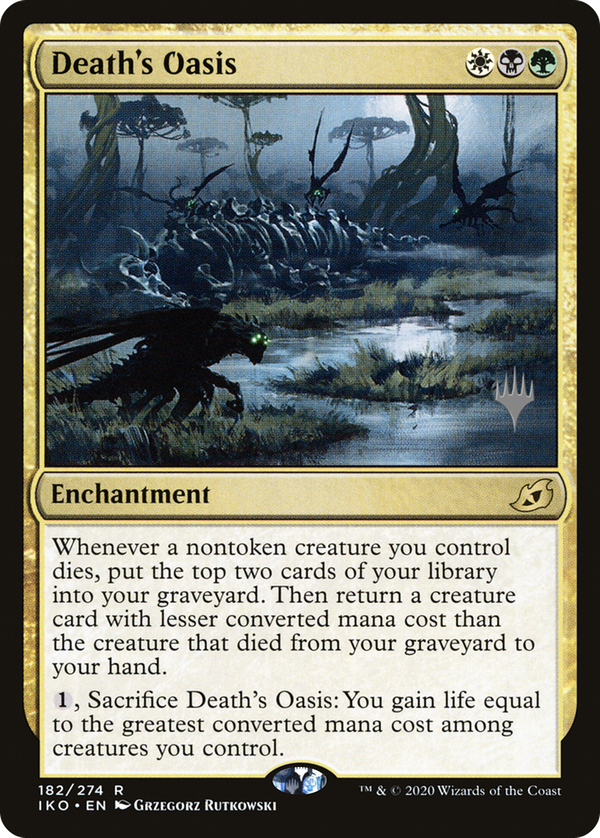
Rules text
 , Sacrifice this enchantment: You gain life equal to the greatest mana value among creatures you control.