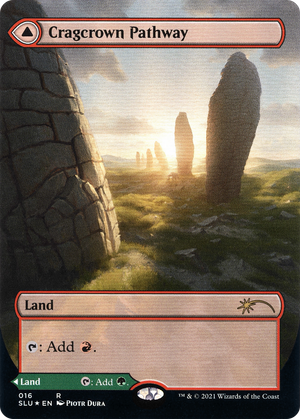
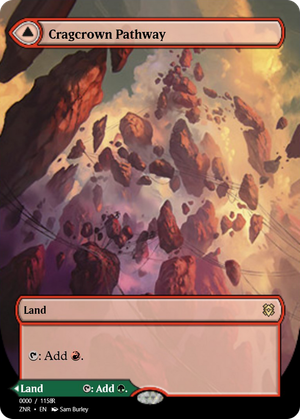
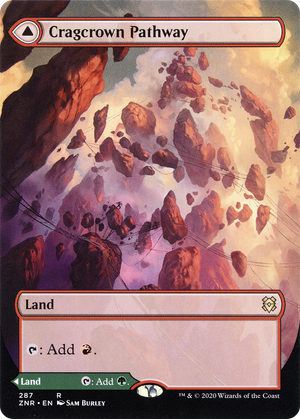
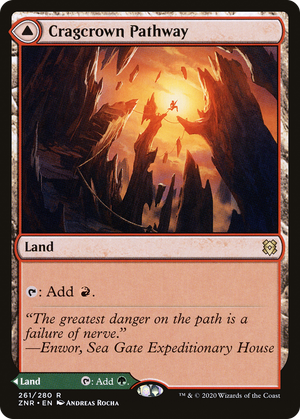
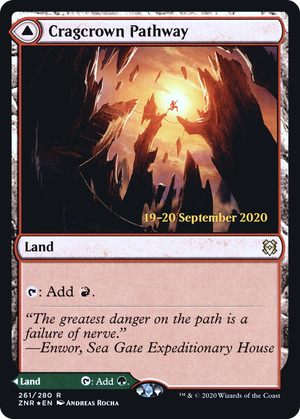
Cragcrown Pathway // Timbercrown Pathway
The problem the Pathway cycle solves is old and specific: a dual land forces its decision at deckbuilding time (untapped this turn or fixed color next turn?), and this land moves that decision to draw time instead. You choose a face when it enters, it produces exactly one of two colors forever after, and it always comes in untapped. That is the whole trade: no life loss like the shocks, no upkeep tax like the painlands, no basic-type dependency like the fetches, no conditional untapped clause like the checklands. What you give up is flexibility once it is down. A Cragcrown Pathway played as its red face is a red source and nothing else; the green half no longer exists on the battlefield. The design reads as color-screw insurance rather than a true dual: it guarantees you can hit one of your colors on curve without ever risking a tapped land, and it accepts that a mana-hungry two-color hand will sometimes want both sides and can only have one. Modal double-faced treatment is what makes this legible: the card is not two lands stapled together but a single land with a fork resolved the moment you decide which face to put down, which is why its converted mana cost sits at zero. The Pathways trade late-game options for early-game reliability, and they make that trade with less friction than any dual before them.
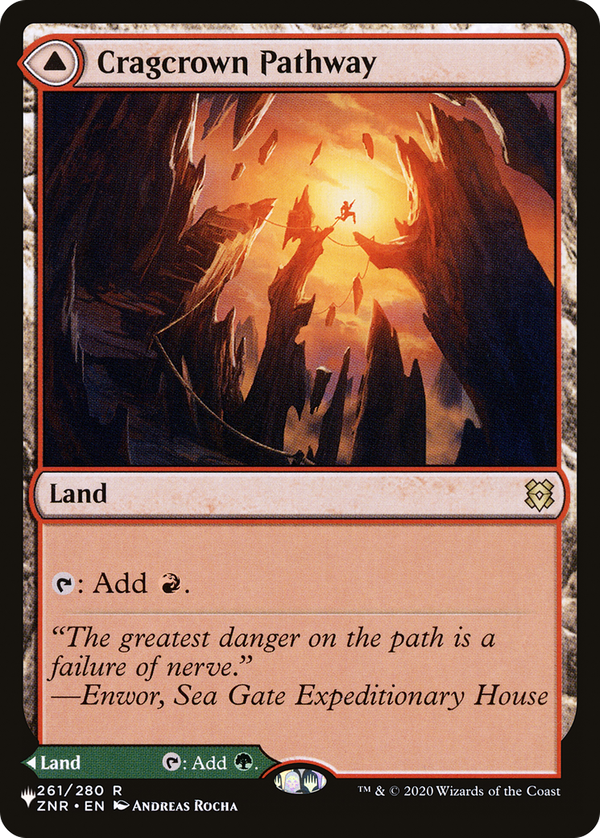
Rules text
 : Add
: Add  .
//
: Add
.
//
: Add  .
.