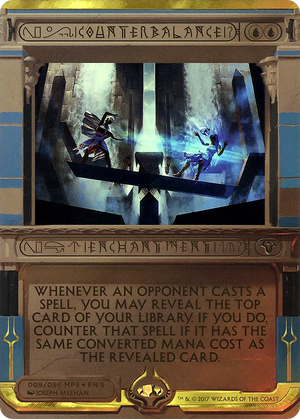
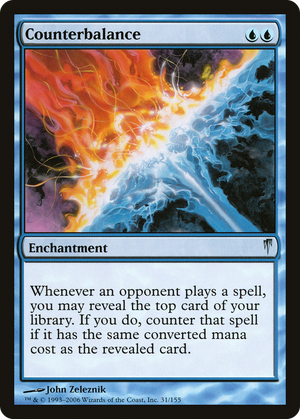
Counterbalance

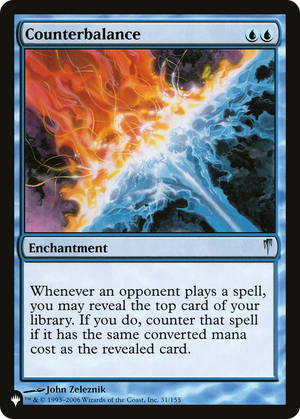
The genius of this card is that it converts your library into a stack of soft counterspells priced by accident of curve. Where a normal counter pays mana to answer a spell, this one costs nothing once it resolves and instead asks you to manufacture the right number on top: hit the same mana value as the revealed card and the spell dies, regardless of color, type, or how hard it would otherwise be to interact with. What keeps it from being a real lock on its own is that the top of the library is a random variable; the design only tightens when you can fix what sits there. That tension is the whole reason it never stood alone. It wanted a reliable way to arrange the top card, and Sensei's Divining Top supplied exactly that, turning a coin flip into a reusable filter you could spin in response to any cast. The pairing produced one of the more notorious soft-locks in competitive history, a control shell that could deny entire swaths of the curve while the Top sat untapped, sculpting the next answer each turn. The trigger itself rewards a deck willing to engineer the future: it goes on the stack when the opponent casts, both players get priority to respond, and only then does the reveal happen, which is precisely the window the Top exploits to load the top card before the counter checks it. It punishes the low end of the curve hardest, where one and two drops cluster and a single revealed card can blank several spells in a row. It is a counterspell whose cost is foresight rather than mana.