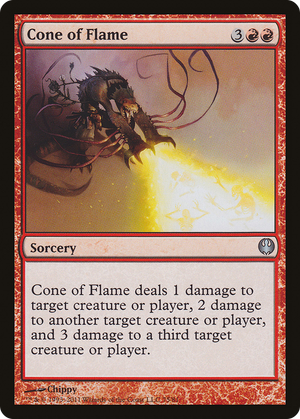
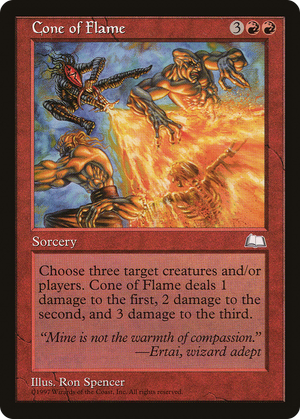
Cone of Flame


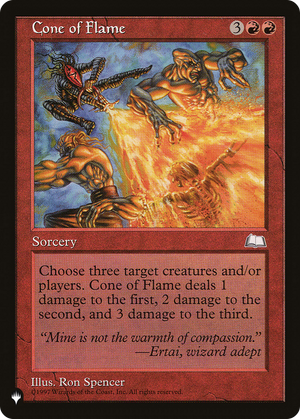
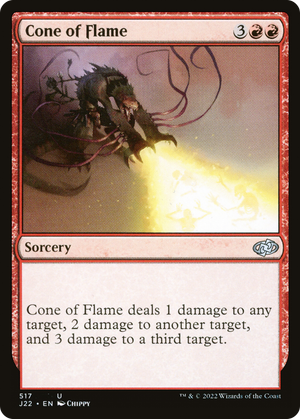
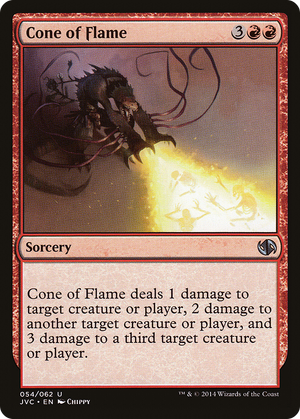
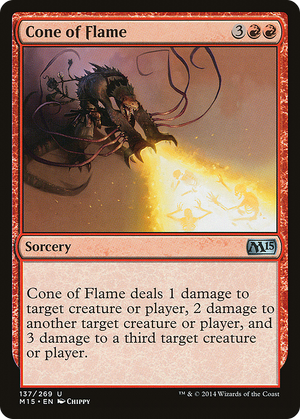
A spread of fixed numbers across three targets is a different design problem than a single bolt, and this early printing of the effect handled it with a clean partition rather than free allocation. The six points are not a budget you carve up; you assign exactly 1, 2, and 3 to three separate things, each of which can be any target, so the rigidity is the whole tension. Against a board of equal-toughness creatures it overspends on one and underspends on the rest; against a curve of different sizes it reads as a two-for-one or three-for-one in a single sorcery. The flexibility lives only in target choice, not in how the points are split: the 1-damage increment can fall on a creature, a planeswalker, or a player just as readily as the 3, which lets you push reach or pick off a small blocker when the boards do not line up perfectly. Set against the school of red sweepers that hand the caster a pool of damage to distribute freely, the partition is the constraint that defines the card. Six damage for five mana is a fine rate on paper; six damage that must land in those three exact buckets asks the caster to find a board state where the arithmetic cooperates rather than rewarding raw versatility.
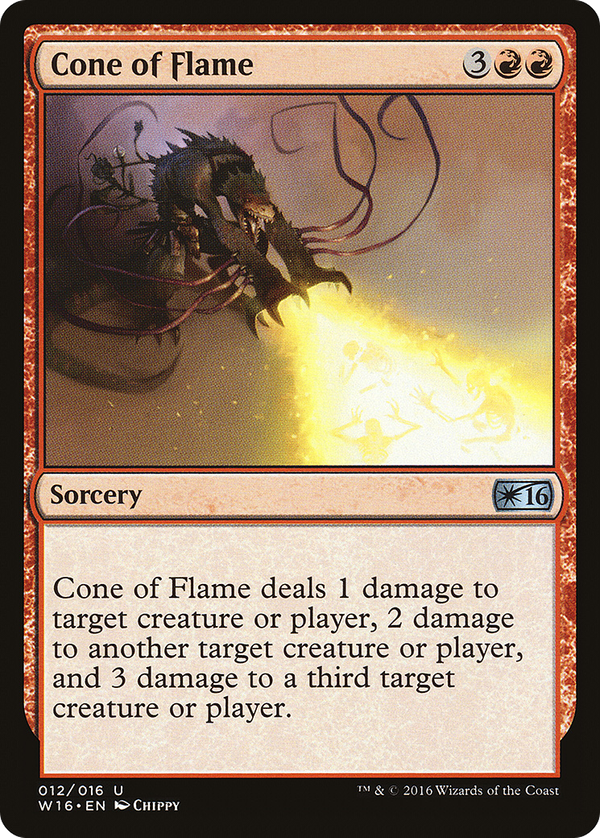
Rules text
Format Status
More formatsFewer formats
Other printings
- The List#WTH-95
- Jumpstart 2022#517
- Duel Decks Anthology: Jace vs. Chandra#54
- Magic 2015#137
- Duel Decks: Knights vs. Dragons#75
- Planechase#52
- Duel Decks: Jace vs. Chandra#54
- Tenth Edition#194