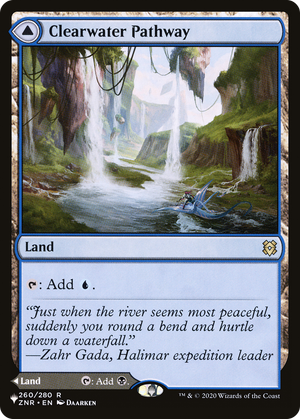
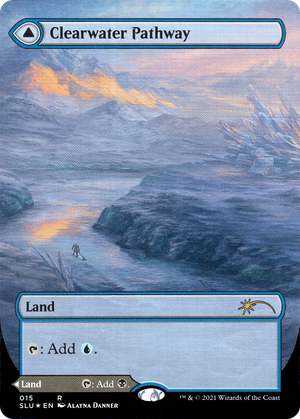
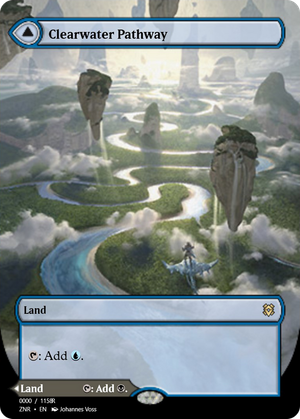
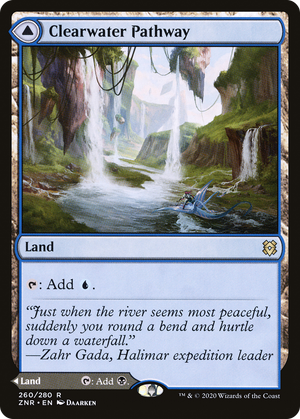
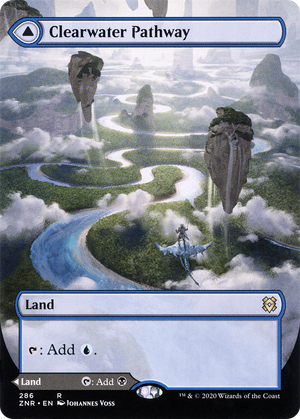
Clearwater Pathway // Murkwater Pathway
The design problem the Pathway cycle set out to solve is the oldest tension in dual-land theory: a land that taps for two colors is powerful, but every version pays a tax for the flexibility (life from a shock, a tapped turn from a check land, a gate on how many other duals you run). The Pathway answer is to refuse the flexibility outright. You choose one face as the card enters and commit to it for the game; the other color is gone. What you buy for that commitment is the thing the cycle protects above all else: an untapped land that produces exactly one color, with no life loss, no basic-type check, and no conditional tapped state. It is a fixer that never fixes twice, and that constraint is the entire point. The modal-double-faced frame does the accounting a split card cannot, because each face is a full land rather than a spell with two halves; the choice happens at the moment of play and cannot be undone. This makes the Pathways read as insurance against color screw rather than as sources of on-demand two-color mana: draw two and you can hedge, draw one and you have already decided which half of your deck it serves. The line between Clearwater and Murkwater is drawn before you know what the game will ask of you, which is a very different bargain from every dual that lets you decide later.
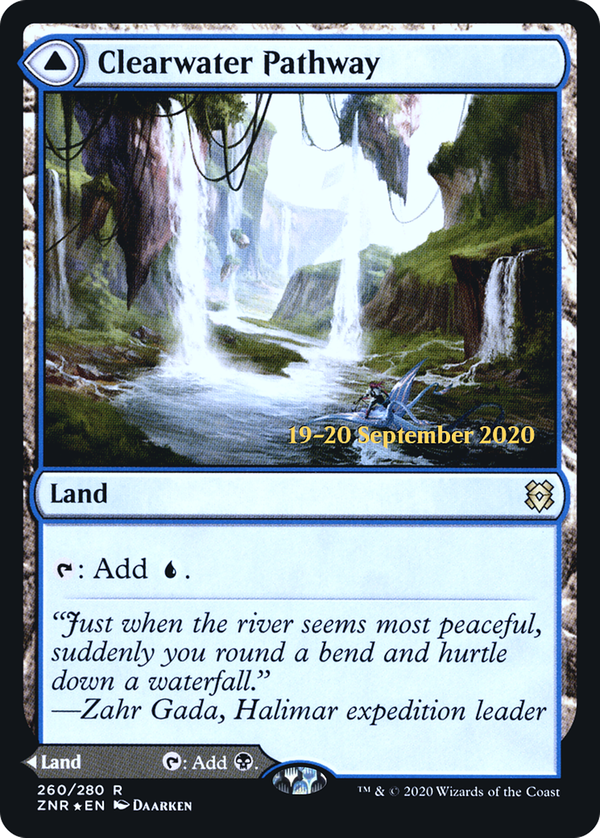
Rules text
 : Add
: Add  .
//
: Add
.
//
: Add  .
.