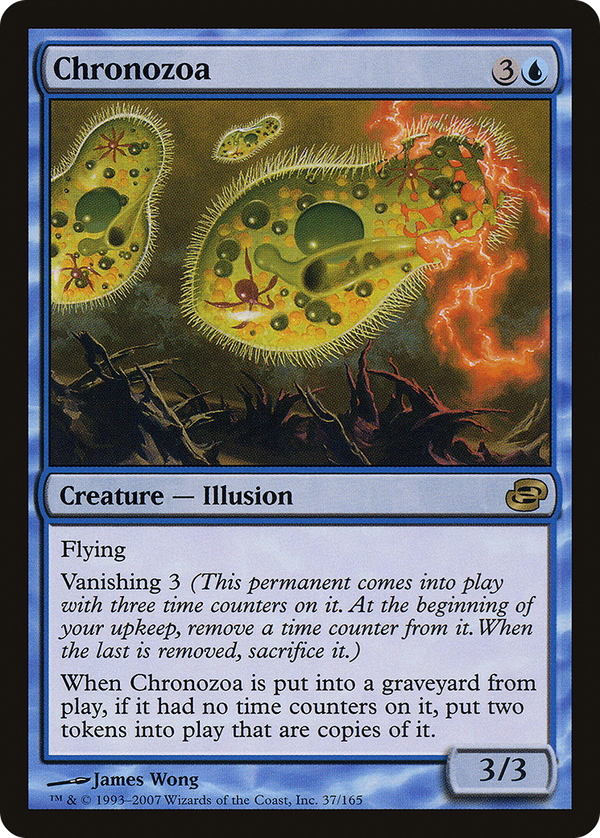
Chronozoa


Vanishing usually reads as a downside: the clock that takes the creature off the board is what pays for an undercosted body. Here the timer is the engine. The death trigger only fires when the creature dies with no time counters left, which is precisely the state vanishing forces on the upkeep after the third counter comes off. So the question is not whether it dies but when, and the card answers it for you: three turns in, it sacrifices itself and leaves two copies behind, each carrying its own fresh three-counter clock to start the cycle over. Left undisturbed, one 3/3 flier becomes two, then four, an exponential cascade gated only by the upkeep cadence. The vulnerability is the same window that powers it: kill it while it still holds counters and the trigger never checks true, so removal that connects early erases the whole tree rather than pruning a branch of it. That splits an opponent's interaction into a real choice rather than a trap. Killing it before the timer runs out genuinely beats the card; the duplication only rewards the controller if the creature survives to the death it was always scheduled to suffer. The pressure, then, runs in both directions: the opponent has to answer it inside three upkeeps, and the controller has to shepherd a creature that is busy trying to die on time, protecting it from premature removal so the clock, not a burn spell, gets to pull the trigger.