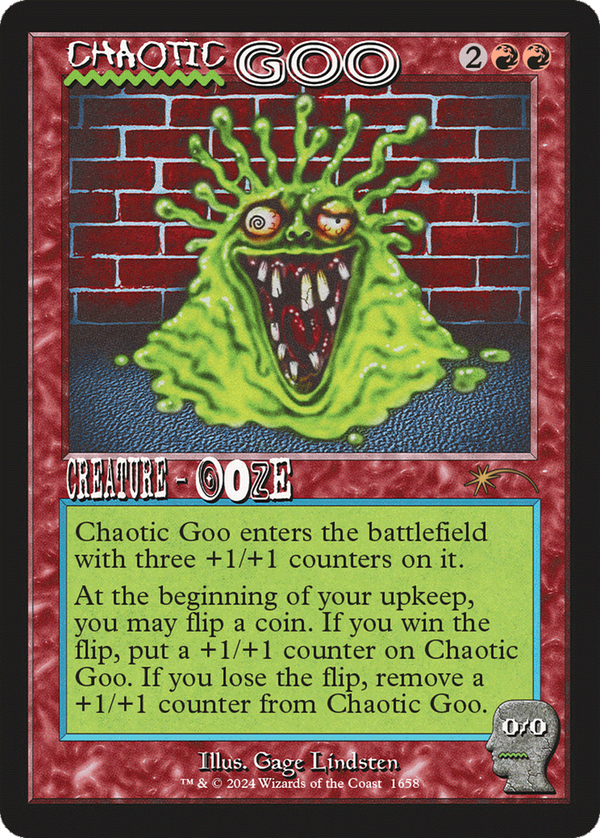
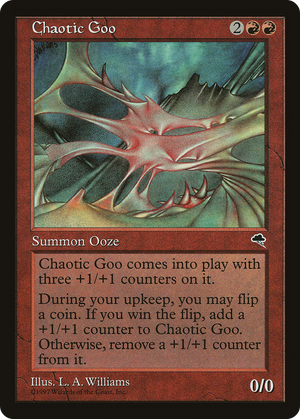
Chaotic Goo


A coin flip stapled to your upkeep, dressed up as a creature. The body arrives with three +1/+1 counters on a 0/0 frame, then every turn asks you to gamble its size against itself: win the flip and it grows, lose and it shrinks back toward the printed 0/0. That last detail is the real teeth of the design. The card has no toughness of its own, so a bad run of flips does not just stall the creature, it kills it outright once the counters are gone. This is variance as a balancing mechanism, the same impulse that produced cards like Mana Clash and Goblin Game in this era of design: Wizards experimenting with whether randomness could be a cost the player accepts rather than a penalty imposed on them. The trouble is that the optional flip is rarely optional in practice; you keep flipping because a frozen Goo is a dead investment, and so the card converts a four-mana 3/3 start into an open-ended bet you can never quite walk away from. It is a snapshot of a specific design philosophy, the late-nineties belief that chaos and coin flips were a legitimate flavor of red, that the modern game has largely retired in favor of variance the player can mitigate.