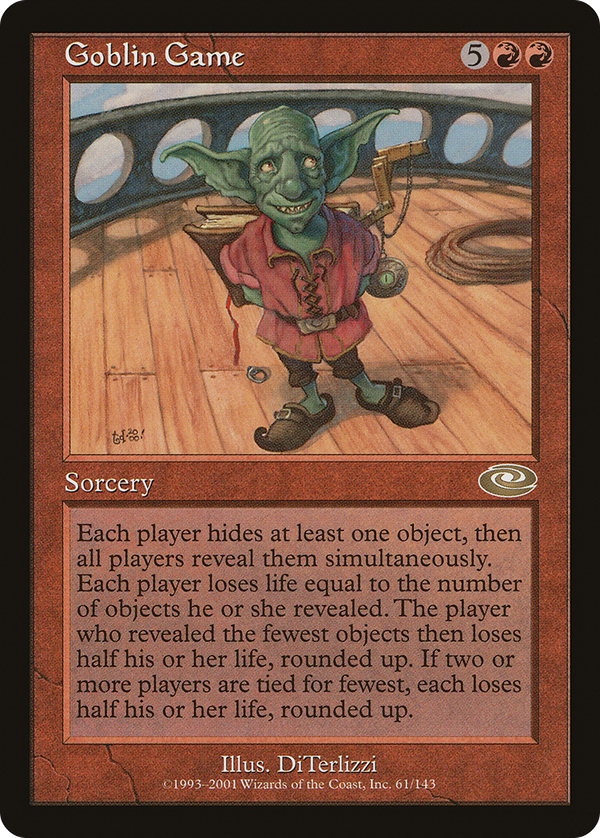
Goblin Game


Few cards demand that you physically hide objects and reveal them on a count of three: scraps of paper, dice, coins, whatever the players agree counts as "an item." The text is a rules nightmare wearing the costume of a party game. Who decides what an item is? Can you hide two hundred? Does a die count as one item or six? The wording has leaned on the comprehensive rules and tournament policy to plug holes the card itself never closed, and judges have spent years adjudicating disputes that boil down to how much salt is on the table. Mechanically it is a guessing game with no good answer: reveal more items and you lose more life directly; reveal fewer and you risk being the one who loses half your life on top. The math only resolves cleanly when every player is committed to losing, which is the joke. This is deliberately silly Magic, the impulse that also produced Chaos Orb and the dexterity oddities, where the design brief was novelty rather than balance. Nobody builds around it because no deck wants a symmetric, unpredictable life-loss sorcery for seven mana. What it represents is an era when Wizards still printed cards as pranks: a punchline rendered as a permanent legal object, funnier on the page than at any actual game it has ever ruined.