Chance Encounter


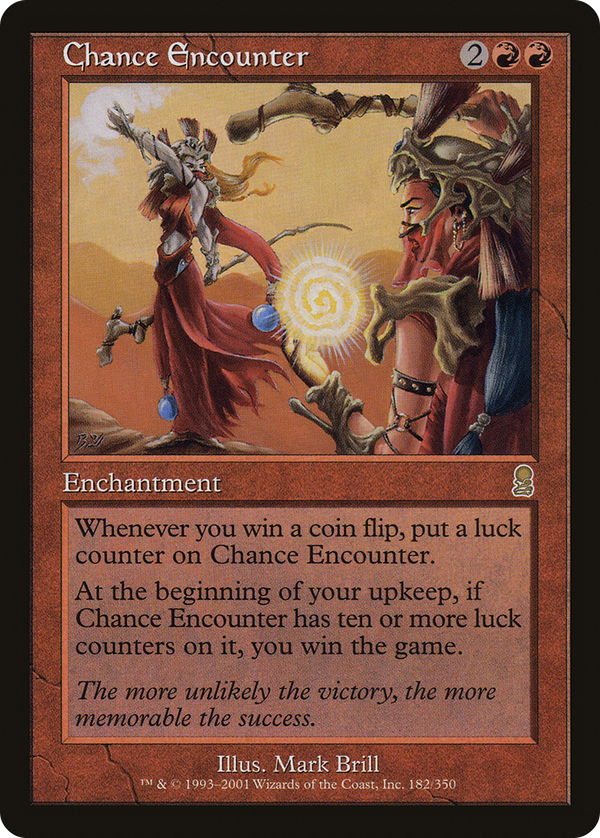
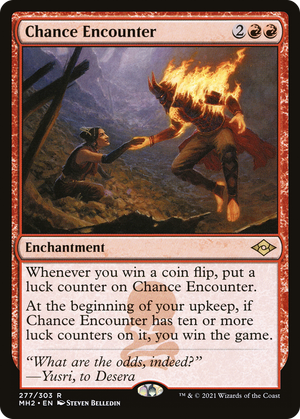
Ten won coin flips, accrued a single luck counter at a time, and your next upkeep simply hands you the game. The math is exactly as forbidding as it reads: each counter demands a flip you have already won, and stacking ten on one permanent is a long shot wearing a win condition's clothing. What keeps the card a perennial object of brewer fascination rather than a shrug is that coin flips stop being neutral the moment you start fixing the inputs. Reroll effects and flip-doublers bend the distribution hard; Krark's Thumb lets you flip twice and keep the result you prefer, dragging each toss far closer to a sure thing. The build-around is a deliberate early-era trap: a ceiling-only payoff gated not by mana, not by board state, but by a string of repeated probability checks, with all the infrastructure to cheat those checks left as the player's homework. The accrual is permanent and one-directional, so the enchantment behaves as a slow ratchet rather than a combo trigger; you are not assembling a loop, you are grinding a counter toward a threshold across many turns. Read as design, it answers a precise question about what a "win the game" enchantment becomes when its price is denominated in luck instead of resources: the improbable rendered as a long-term project rather than a flat impossibility.