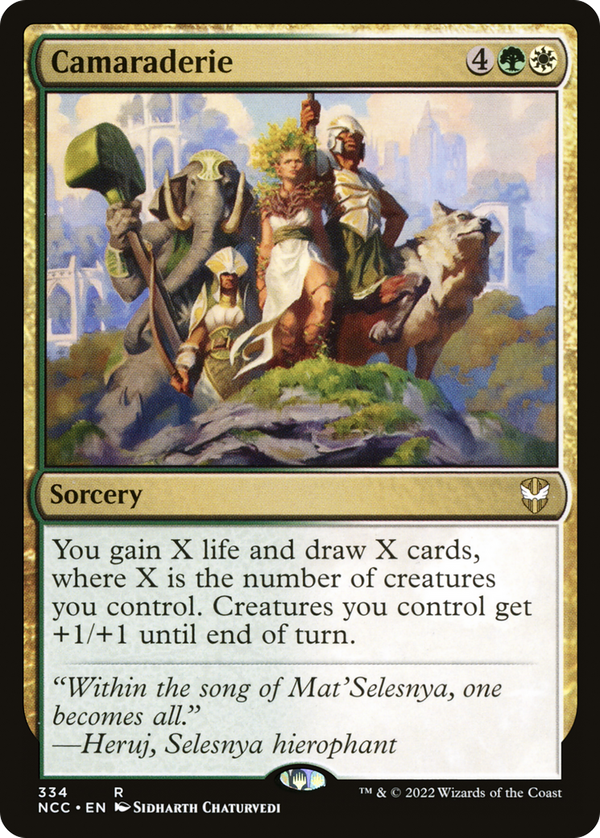
Camaraderie



The payoff scales three ways off one number, and that triple-counting is the whole design pitch. Where most go-wide payoffs commit to a single axis (overrun your opponent, refill your hand, or pad your life total), this fires all three from the same creature count: the board you already have becomes a life swing, a card draw, and an attack step in one sorcery. The anthem buff lands last in the text but matters most in practice, since +1/+1 across the team turns a stalled board into a clock the same turn you reload. The cost is the honest part of the bargain: at six mana and sorcery speed, it does nothing for an empty board, so it only rewards a deck that has already done the work of flooding the table. That is a fundamentally different proposition from a card-advantage spell you can cast on turn two to dig toward a plan. Here the spell is the reward for the plan having worked. It belongs to the lineage of token-and-anthem finishers that ask you to build a wide board first and cash it in second, with the wrinkle that the cash-in spans the resource economy (life, cards, damage) rather than picking one. The ceiling is enormous and the floor is a dead card in your hand, which is exactly the shape a go-wide payoff is supposed to have.