Brilliant Ultimatum



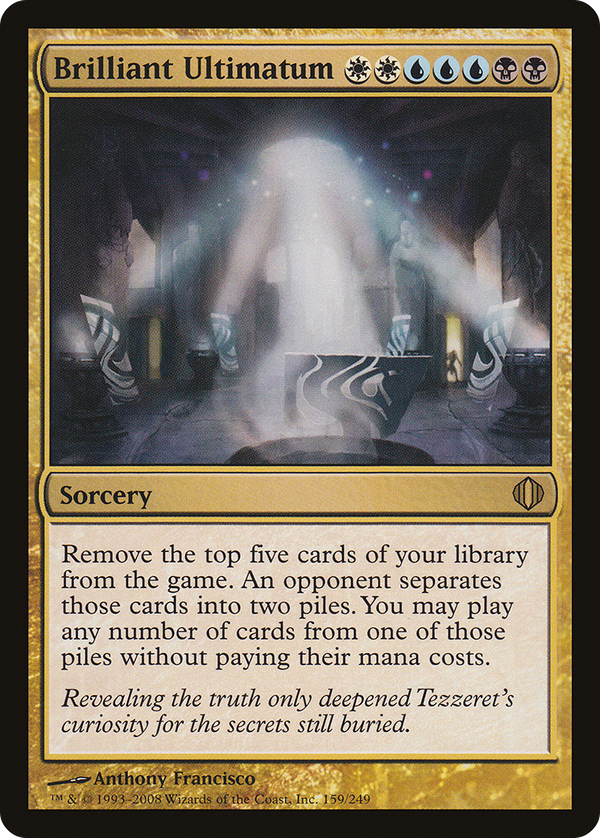
Seven mana across three colors of the Esper shard, paying off into free spellcasting and then handing your opponent the scissors: this is the Fact or Fiction structure scaled up, and the design tension lives entirely in who does the splitting. You exile five, the opponent makes two piles, and you take one and cast its spells for nothing. The cards are yours, but the division is theirs, which means the value you extract is exactly the value your opponent decides they can live with you having. A skilled splitter neutralizes the upside by pairing your bomb with four blanks, or by carving two roughly equal piles where neither half closes the game. The cast-without-paying clause is genuinely enormous, capable of dumping a fistful of expensive spells onto the battlefield in a single turn, but the pile mechanic is the leash, and exiling five off the top means whatever your opponent buries in the dead pile is simply gone. The interesting design question it poses is symmetry under adversarial control: most free-spell payoffs let you choose what you get, while this one externalizes the choice to the person least inclined to help you. That makes it less a tutor than a negotiation, where every line of play is shaped by what your opponent is willing to concede. The triple-blue, double-white, double-black requirement plus the seven total pips marks it as a showcase build-around, the kind of high-rarity gold card written to be a story at the table rather than a reliable engine.