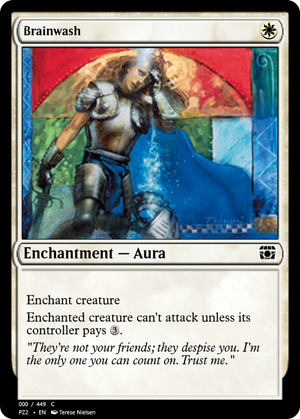
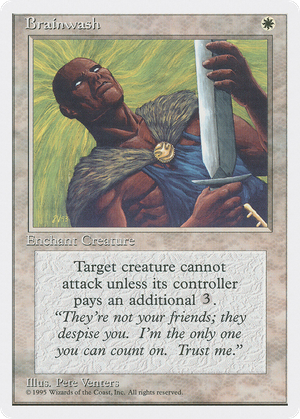
Brainwash

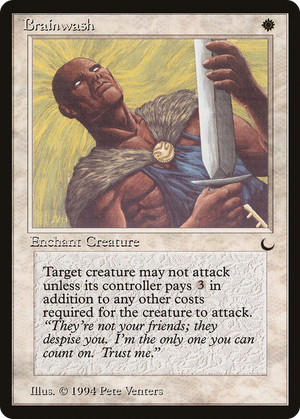
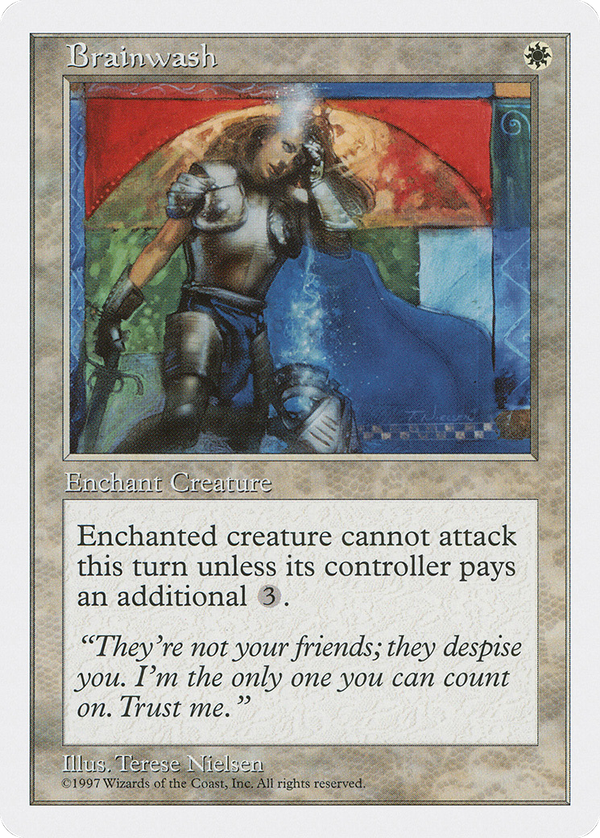
White's early answer to a large threat was rarely outright removal but restriction, and this is the cheapest, most conditional flavor of it: a recurring toll on attacks that leaves blocking, abilities, and everything else untouched. The design is Pacifism logic softened to a tax. Rather than shutting the creature off, it bets on a specific economic premise: that paying  every combat step is a lot, and that a creature held back is as good as a creature dealt with. That gap defines the card. The enchanted creature can still defend, still tap for whatever it taps for, still chump back. You are only buying time on offense, and only if the opponent declines to spend. The math has aged badly. Three generic mana was a real cost when mana was scarcer and rituals rarer, but the tax scales poorly against any deck that floods out, and against a creature whose controller never wanted to attack it does nothing at all. The line between a frustrating lock and a dead card runs entirely through how badly the opponent needs that one creature to swing. It is a precise artifact of an era when white solved combat math by making attacking expensive rather than impossible, a holding pattern committed to cardboard.
Rules text
.