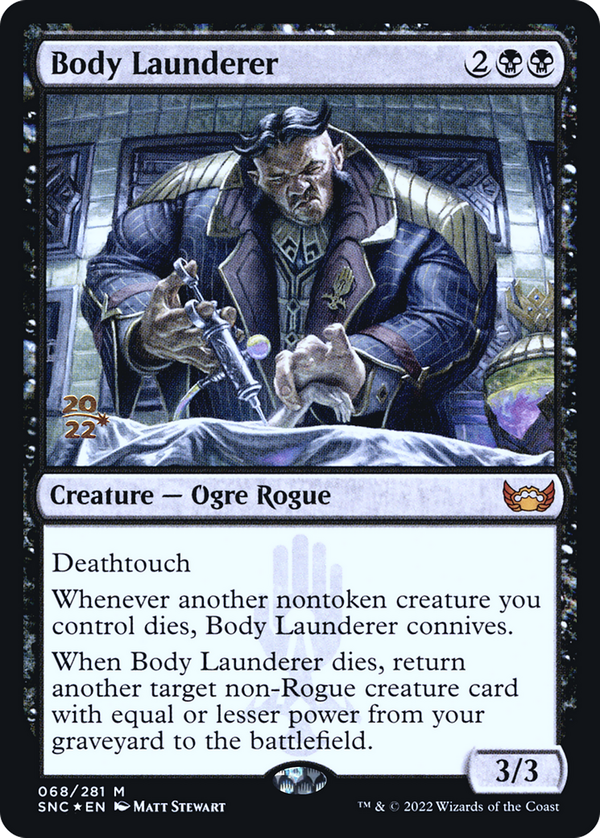
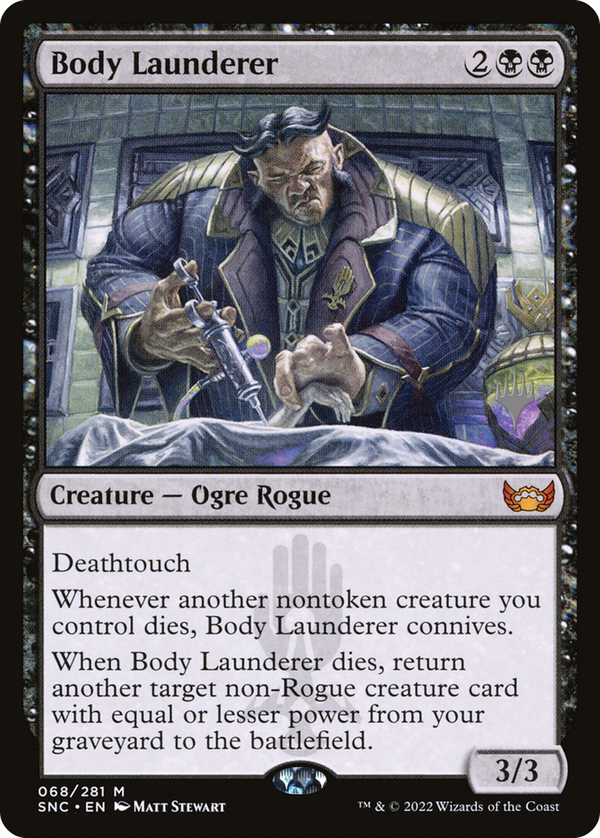
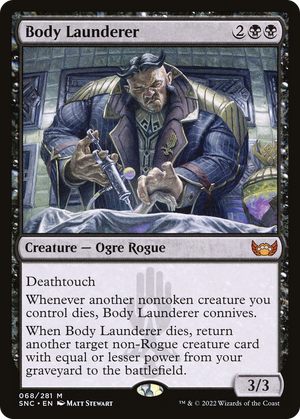
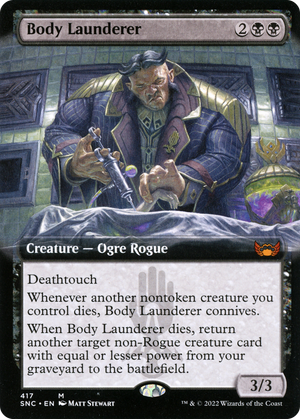
Body Launderer


The design here reads sacrifice fodder as a two-stage payoff, and both stages point at the same graveyard. Every other nontoken creature that dies under your control feeds the connive, so this thing grows and filters your hand off the same deaths an aristocrats deck is already generating; deathtouch keeps it relevant in combat while it does. The real value is deferred to its own death, when it drags a non-Rogue creature of equal or lesser power back to the battlefield, and the sizing clause is what balances that recursion: the connives that fattened it also raised the ceiling on what it can return. Build it up, then trade it in, and you cash out into a bigger body than you started with. The non-Rogue exclusion is the discipline that stops the obvious loop: it cannot reanimate another copy of itself, so you can't chain deaths into an infinite recursion engine, and it steers you toward reanimating the actual threats rather than the enabler. What looks like a midrange value creature is really an engine that wants to die on your terms, ideally into a sacrifice outlet with something worth returning waiting in the yard. The connive-on-death trigger and the reanimation-on-death trigger are two clocks measuring the same event from opposite ends: one rewards the deaths leading up to it, the other rewards the death that ends it.