Blood Spatter Analysis


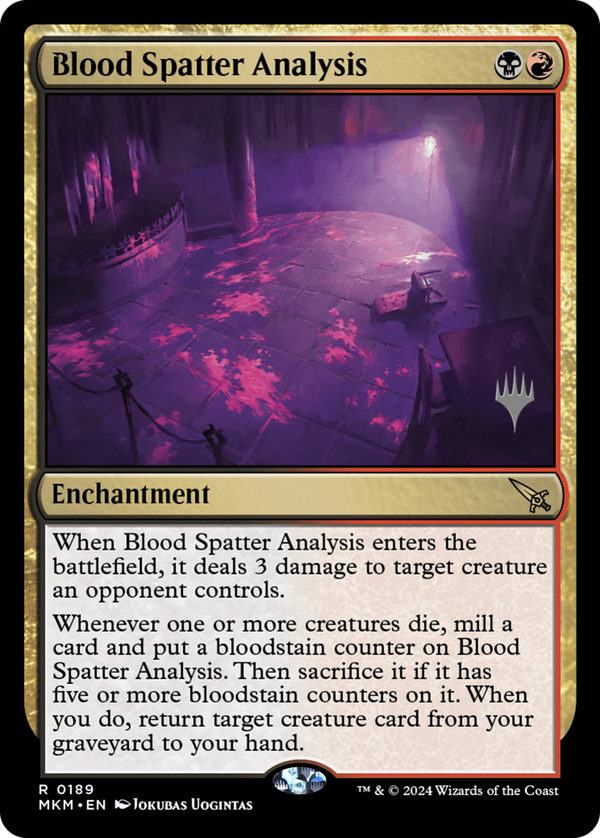
The two lines pull in opposite directions, and that friction is the whole design. The enters-the-battlefield burn is immediate removal: three damage to an opposing creature, front-loaded so the card earns its slot the turn you deploy it. Everything after is a slow dividend that asks you to leave the enchantment on the board while bodies fall. The engine ticks on a batched trigger: any death event where one or more creatures die mills a single card and adds a single bloodstain counter, so a board wipe that kills six advances the count by exactly one, the same as a lone chump block. What it batches, though, is simultaneity, not the turn: a sacrifice followed by a removal spell in the same turn are separate death events, and each adds its own counter. That is the wrinkle that makes an aggressive, self-sacrificing Rakdos board a faster fuse than a durdling one. At the fifth counter the engine cashes out, sacrificing itself to return a creature card from your graveyard to your hand, and the card you recur is often something the mill buried on the way up: the same clock that arms the payoff also stocks it. Crucially, it returns the creature to hand rather than to the battlefield, so you still pay to recast it. That is why the counting can be as steep as it is without the enchantment ever threatening to be a two-mana reanimation loop; five is high enough that the recursion stays a grind rather than a giveaway.