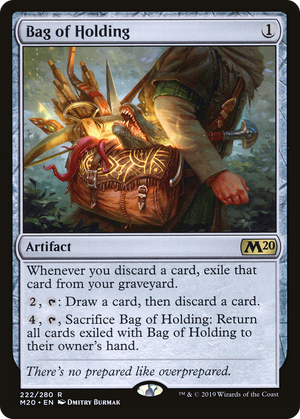
Bag of Holding

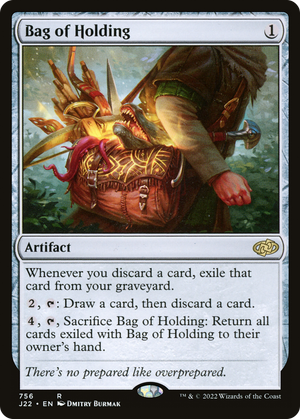
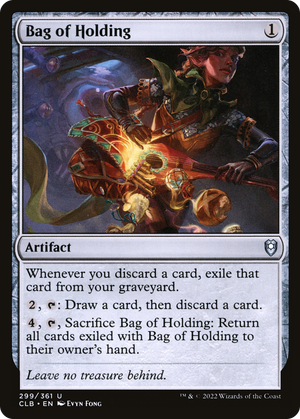
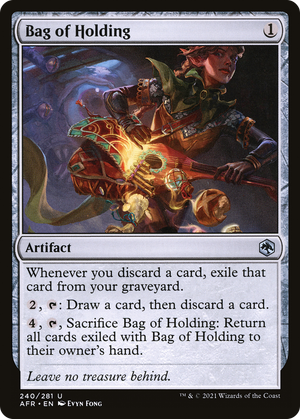
The wrinkle here is that discard, usually a cost you pay grudgingly, becomes storage. The first ability is a triggered one: whenever you discard a card, it exiles that card from your graveyard onto the artifact instead of leaving it in the bin. Because it uses the stack, it can be responded to, but in practice it quietly rewrites what happens to a discarded card, feeding the bag rather than the yard. That reframes an entire category of effects. Cards that make you discard as an activation cost stop being a resource leak; loot and rummage effects that would bin your hand instead park it for later. The draw-then-discard ability built onto the same artifact is the on-board engine for this, digging while banking the discards it generates. Most self-mill and rummage payoffs want the graveyard as a live zone; this instead treats the bag as a delayed second hand, trading the flexibility of graveyard recursion for a bulk refill that dodges graveyard hate by not being in the graveyard at all. The tension is timing: everything the bag holds returns in a single burst for four mana and a sacrifice, so the payoff is not incremental card advantage but a stockpile you cash in on one turn. As a one-mana artifact it costs almost nothing to deploy, which is the point: the bag wants to sit on the battlefield filling up before it ever pays out.
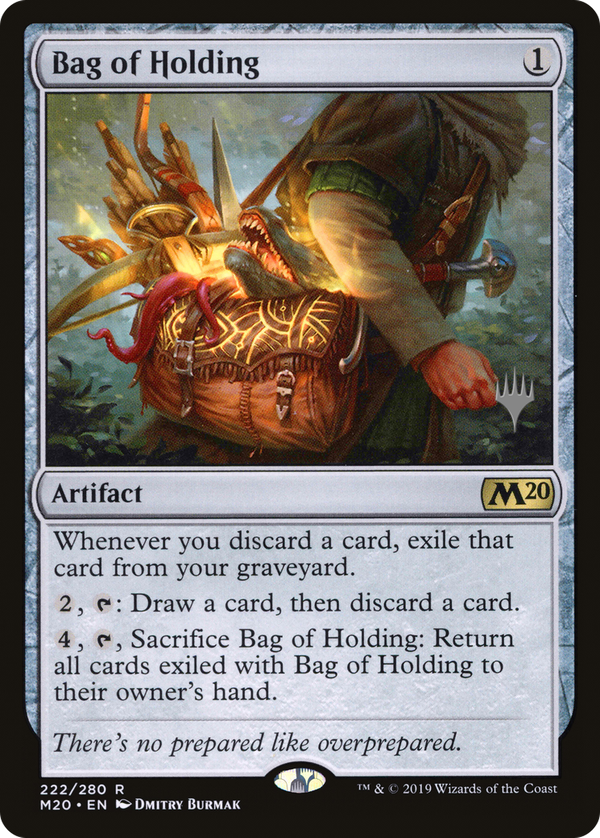
Rules text
 ,
,  : Draw a card, then discard a card.
 , , Sacrifice this artifact: Return all cards exiled with this artifact to their owner's hand.