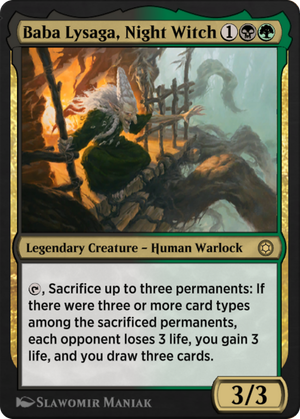
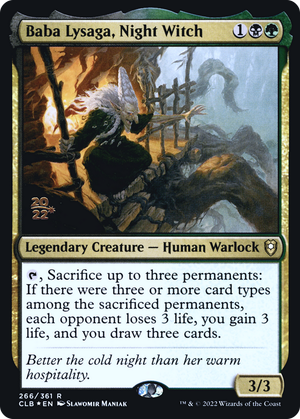
Baba Lysaga, Night Witch



The three-or-more-card-types gate does all the balancing work here, and it does it with no mercy: you can tap and sacrifice up to three permanents, but if those permanents fail to span three card types, the ability still resolves and pays out nothing. No partial refund, no consolation. That single binary condition turns a generic Golgari sacrifice outlet into a puzzle about board composition. You cannot feed it a pile of tokens or a stack of creatures and expect the drain-gain-draw payoff; you need genuine breadth on the battlefield, which pushes a deck toward artifacts, enchantments, expendable lands, and creatures all coexisting so any given activation clears the bar. That is a very different building requirement from the usual aristocrat commander, which wants fungible bodies to loop. The reward stacks three of the most contested currencies at once (a three-point drain, three life back, three cards deep), but the tap and the all-or-nothing threshold keep the rate honest: you get one crack per turn, and if you mistime the board state, that window is simply spent. Fodder here is an accounting problem as much as a sequencing one. Before every activation you are counting card types on the table, deciding whether cracking now meets the three-type minimum or wastes the turn's only shot. A 3/3 that asks you to keep a graveyard-feeding board diverse rather than deep is a rare thing in a color pair built around throughput.
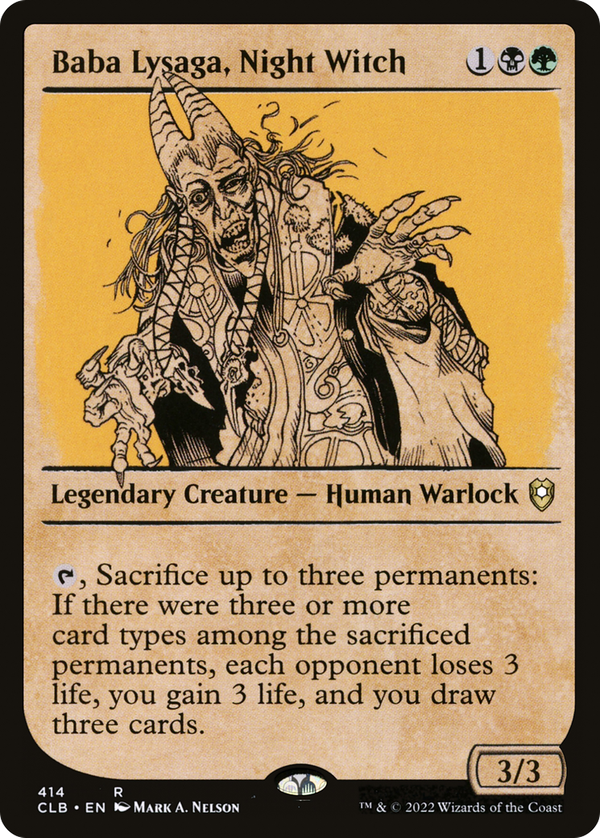
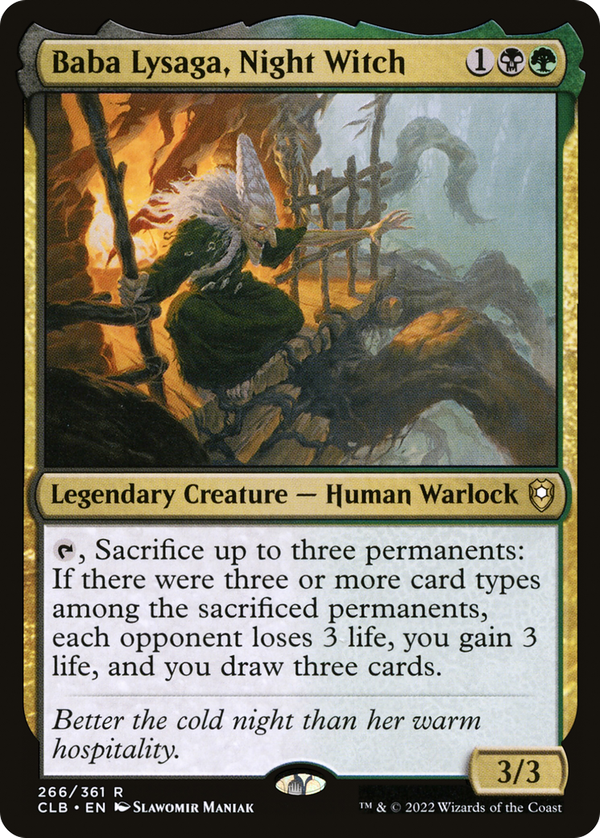
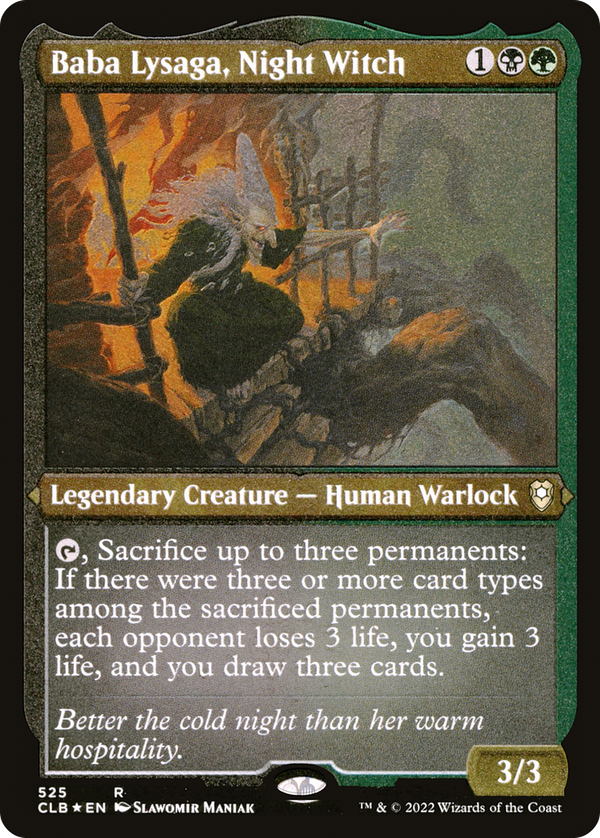
Rules text
 , Sacrifice up to three permanents: If there were three or more card types among the sacrificed permanents, each opponent loses 3 life, you gain 3 life, and you draw three cards.