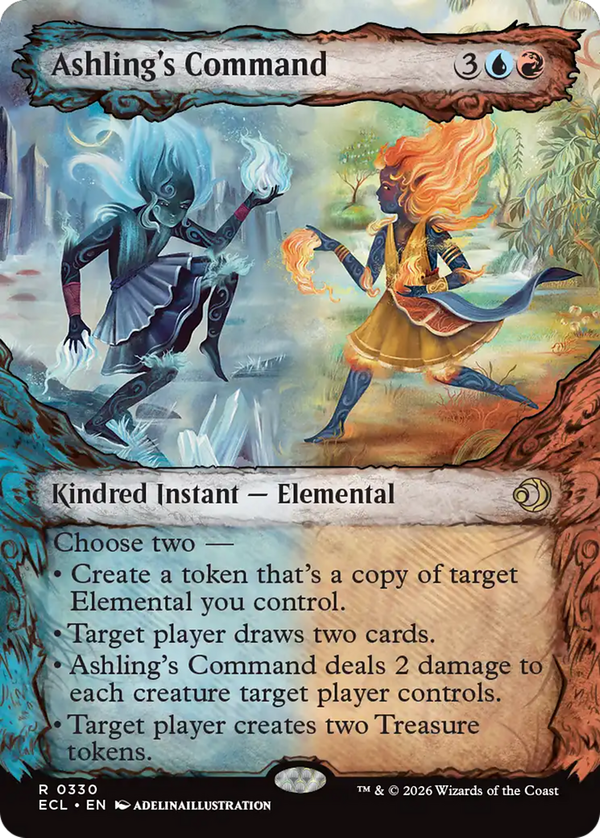
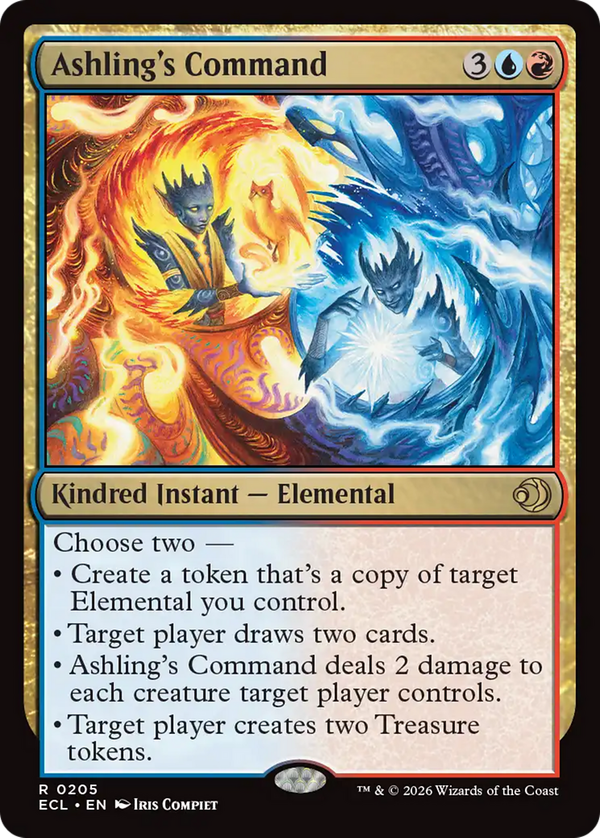
Ashling's Command



The command cycle has always leaned on a simple contract: pay a premium rate for one card, then pick two of four effects and let the flexibility justify the cost. What distinguishes this one is how oddly its four options fit together. Copying an Elemental you control is a tribal payoff, the kind of mode that only earns its slot in a deck built to have an Elemental worth duplicating; drawing two, ramping into two Treasures, and sweeping small creatures for two are generically useful in almost any Izzet shell. That split means the card reads very differently depending on who holds it. In a dedicated Elemental deck it becomes a value engine that duplicates a threat while doing something else; everywhere else it collapses into an instant-speed toolbox that refuels, develops, and clears the way. The instant timing is what ties the modes together into more than the sum of the rate: leaving five mana open through an opponent's turn is a real tax, but it buys the right to wait until their end step and choose between drawing, ramping, and sweeping based on what the board actually did. Most modal instants ask you to guess right at cast; this one lets you hold the decision until guessing is unnecessary, provided you can afford to sit on the mana. The copy clause is the flavor anchor and the tribal hook, but the reason the card travels is that three of its four lines need no build-around at all.