Ashling the Pilgrim


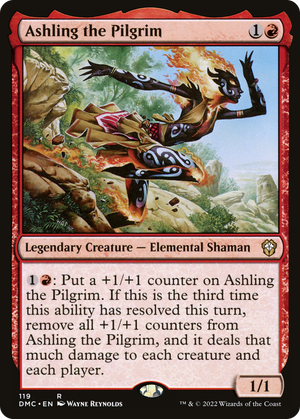
A timer wearing a creature's clothes. Each adds a counter, but the payoff only arrives on the third resolution within a single turn: three iterations, six mana sunk in one window, before Ashling sheds her accumulated counters and detonates for that much damage to every creature and every player, herself included. The design tension lives entirely in that "this turn" clause. You can grow her slowly across multiple turns as a small beater, banking counters that stick around, but the board-and-life sweep only fires if you commit all three activations in one turn, which broadcasts the kill a beat early and asks whether you can survive your own blast. The amount scales with how patient you've been: counters carried over from earlier turns count toward the final tally, so a long game can turn the third pump into a far larger explosion than a single turn's math implies. The charge-and-release idea rarely gets stated this cleanly: a 1/1 that threatens nothing on arrival, then waits to become a one-card Pyroclasm-plus-burn on whatever turn you decide to spend the full sequence. The cost to fire is public and repeatable; the question the card poses is always whether the explosion hurts the table more than it hurts you.
Rules text
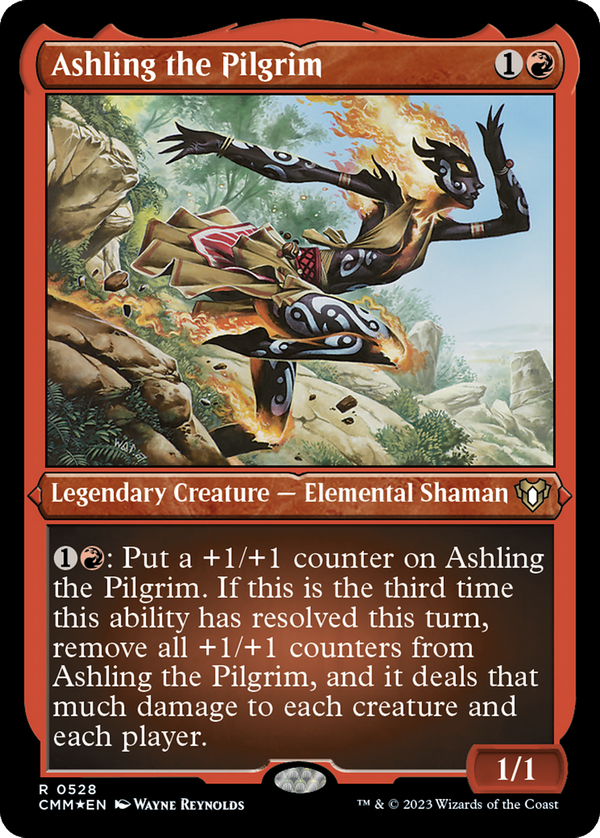
: Put a +1/+1 counter on Ashling. If this is the third time this ability has resolved this turn, remove all +1/+1 counters from Ashling, and it deals that much damage to each creature and each player.