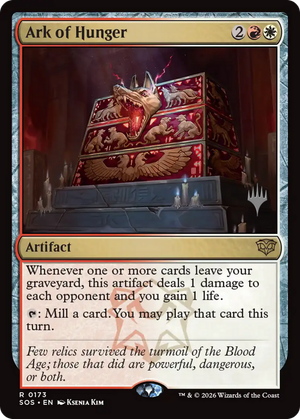
Ark of Hunger



Most self-mill payoffs care about cards entering the yard; this one flips the trigger, rewarding you for cards leaving it. The tap ability supplies its own fuel, milling a card you may then play from the graveyard that same turn, so each activation can run as a two-part loop: dig, then play the milled card to ping each opponent and pad your life total. The elegance is that any graveyard exit counts, not just this artifact's own play-from-yard clause. Flashback, delve, escape, disturb, and every recursion engine that pulls a card back for value becomes incidental Boros drain, because the payoff never asks what the card does or where it goes next: it only asks the card to move. That reframes graveyard interaction on your own side of the table, turning the loops other decks rely on for card advantage into a clock. The mill keyword here is an engine, not disruption; the card is built to feed itself while a wider recursion shell converts each returned or replayed card into reach. It lives at a seam two archetypes rarely share in one color pair: red's cast-from-elsewhere impulse toward playing cards from anywhere, and white's patient graveyard-recursion toolbox, welded together by a payoff that triggers on nothing more than a card crossing out of the yard.
Rules text
 : Mill a card. You may play that card this turn.