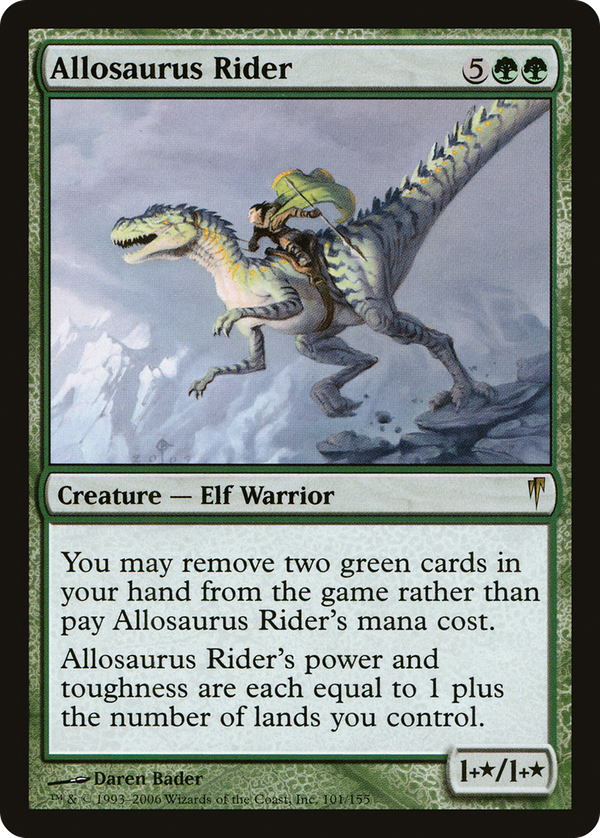
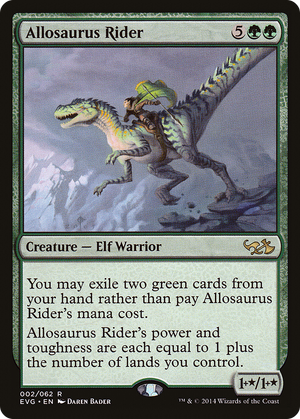
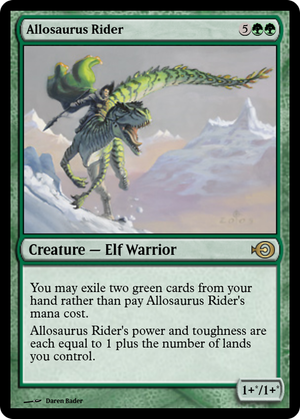
Allosaurus Rider


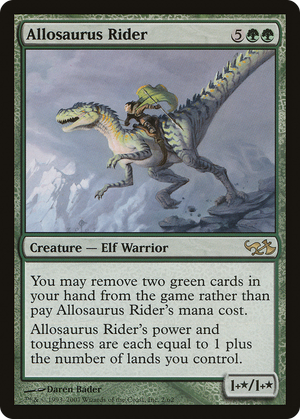
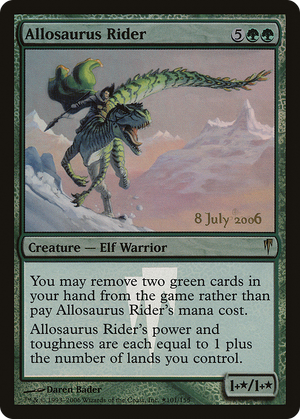
The body was always a decoy. Nobody resolves this as a beater whose stats key off lands in play; the pitch clause is the whole reason anyone runs it. Exiling two green cards from hand puts the Rider on the stack for free, and once it is a creature on the battlefield it becomes a fully assembled body that a deck can immediately convert into something else. The textbook line pitches a pair of green spells to deploy the Rider, then uses something like Neoform or Eldritch Evolution to trade that newly free body up into a much larger payoff, profiting on the mana and the tutor in one motion. That is a different card than the printed text reads as: a zero-mana enabler hiding behind an oversized Elf Warrior whose characteristic-defining stats almost never matter. The friction is that the two exiled cards leave the game entirely, so the combo has to recoup more than it spends, and green spent the better part of a decade circling builds clean enough to make that math work. It is a recurring lesson in how alternative costs get evaluated: the moment a cost can be paid with cards rather than mana, designers stop pricing the spell by its mana value and start pricing it by what the freed-up tempo can be cashed into. The Warrior on the front is the joke; the exile clause is the engine.