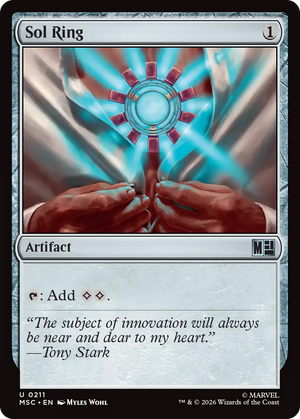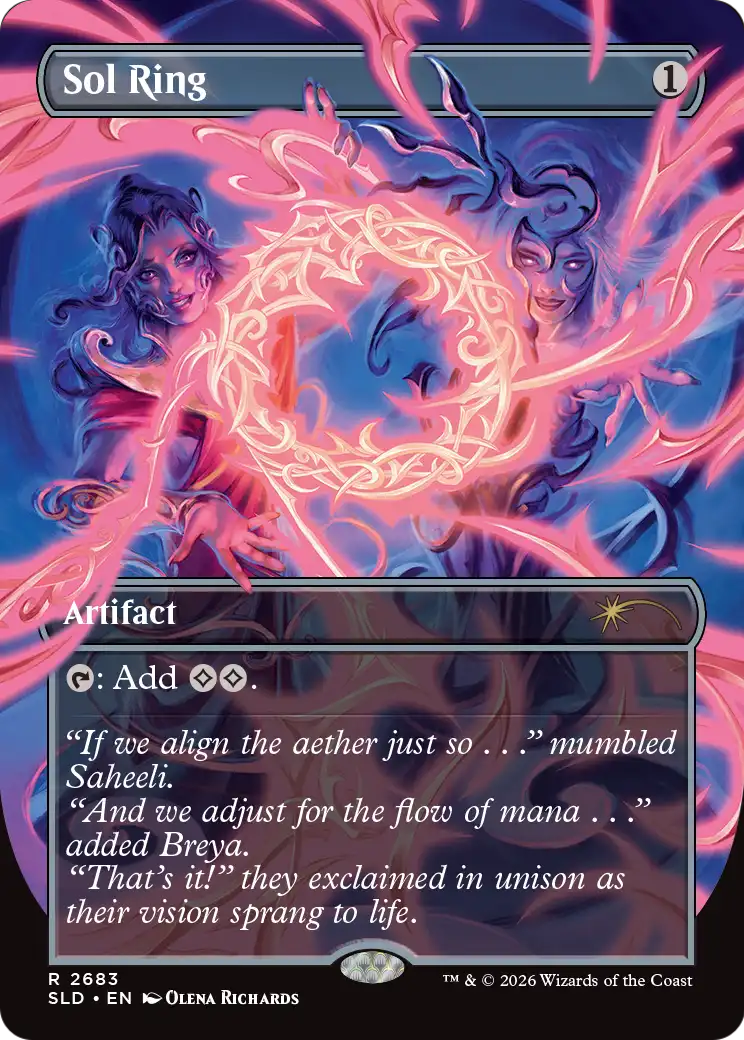
Sol Ring has the dubious honor of being the most-printed card in Magic. Search any modern card database and you'll find well over a hundred distinct printings, more than any creature, any spell, any iconic land. How did a 1993 rare end up everywhere?
The original
Sol Ring debuted in Limited Edition Alpha in August 1993, as a mythic-feeling rare years before mythic was a rarity. The text was simple: tap to add two colorless mana for a single mana investment. The card was, depending on who you ask, either a brilliant design or a thirty-year mistake.
The banlist tour
Sol Ring's competitive history is short and dramatic.
- Banned in Standard before banlists were really a thing
- Banned in Legacy since the format's inception
- Restricted in Vintage, where you can only play one copy
- Banned in basically every constructed format
In a fast format, Sol Ring is just a mana advantage too cheap to print. Two extra mana on turn one means a turn-three planeswalker, a turn-two Karn, an early Force of Will with mana up. The card has never been balanced for sixty-card play.
The Commander exception
Then Commander happened. The format embraced Sol Ring as a defining card, partly because the format embraces splashy plays, partly because every deck wants one, but mostly because the format's power level is high enough that "fast colorless mana" doesn't break it the way it breaks Modern.
Sol Ring is the closest thing Commander has to a constitutional amendment. Banning it has been proposed periodically and rejected every time.
The reprint engine
Once Sol Ring became Commander's signature card, Wizards leaned in. Every Commander preconstructed deck includes one. Every Commander-themed product reprints it. It's been bundled in dozens of Secret Lair drops, special editions, and promotional products. The result: a card that was Alpha-rare in 1993 is now arguably the most accessible piece of cardboard in Magic.
It's a fitting fate for a card that was always too good for the format that printed it.