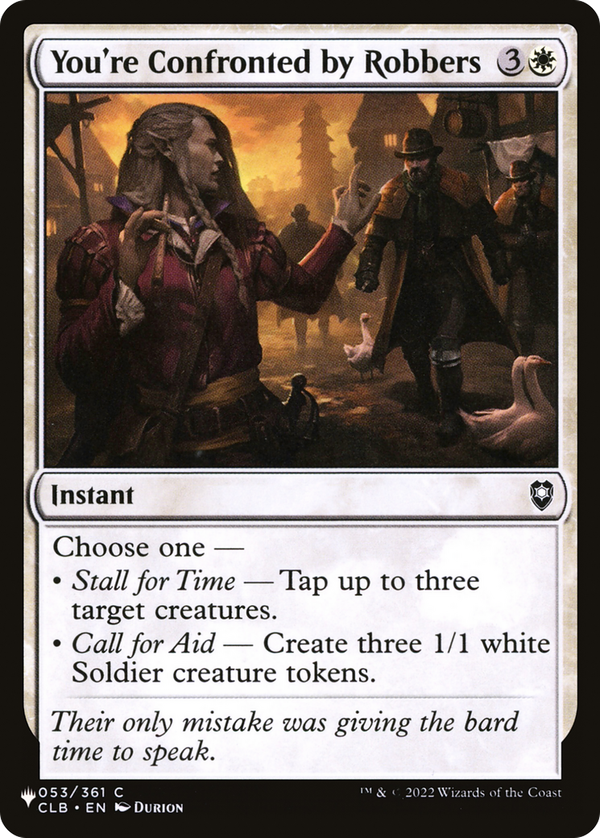
You're Confronted by Robbers


The choose-a-branch framing is the whole draw: a storybook encounter prompt dressed as an instant, a fork in the road where you pick which consequence you can live with. The two modes solve unrelated problems from the same slot. The tap branch blanks would-be attackers before attacks or clears a path by tapping down would-be blockers before blocks, though it does nothing to stop those creatures from untapping on their controller's next turn; it buys a single beat, not a lock. The token branch is proactive board-building, three 1/1 Soldiers to go wide in white's oldest idiom. That split is what justifies four mana: the premium buys the right to defer the choice until the situation forces one on you. Because both branches resolve at instant speed, the card can wait for an attack to be declared or a race to demand bodies, so a mode you committed to too early never curdles into the wrong one. Neither branch is a bargain measured against a dedicated card, and paying more for the fork is exactly what modality costs: flexibility gets bought with rate, so the effect pays off precisely when the board is unsettled enough that holding both doors open beats a cheaper, narrower spell. The italicized Call for Aid and Stall for Time labels are flavor words with no rules weight, set dressing for a die-roll-style encounter, but underneath sits a clean measure of how much white will spend to keep its options live until the last possible instant.