Your Temple Is Under Attack


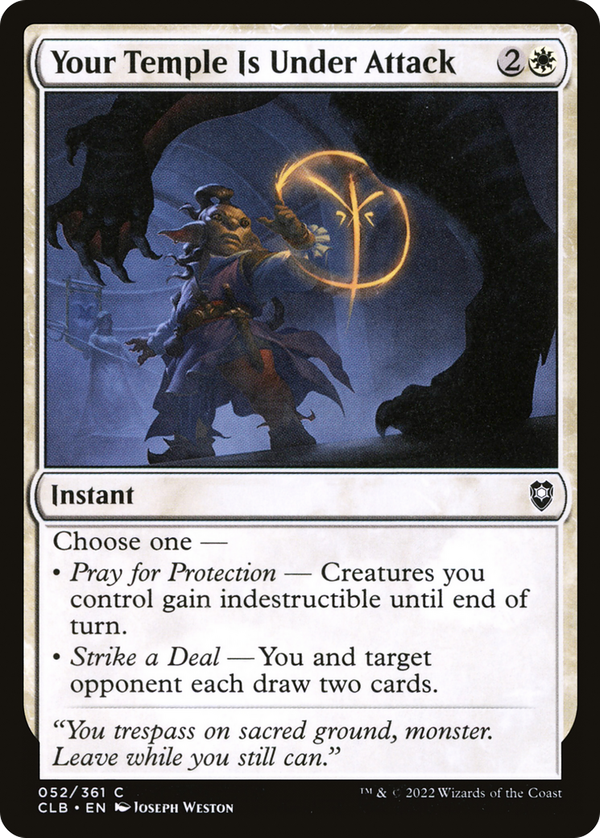
The two italicized labels here are flavor words, not keywords: they carry no mechanical weight beyond the modal choice, and exist to frame each half in the language of a dungeon master offering a bargain rather than a raw toggle. Mechanically, the split gives you a fog-adjacent defensive line (a blanket indestructible that answers a board wipe or turns a bad block into a survivable one) or a symmetrical two-cards-apiece draw. That second mode is the more interesting half, and the more revealing about how white's card advantage gets designed: pure white draw is scarce and usually fenced by a shared cost, so the deal hands your opponent the same two cards you take. The card's whole strategic pivot rests on which side of that exchange you can afford. In a defensive posture you take the protection and treat the draw as a bluff; when you are ahead on board and behind on gas, you let an opponent draw alongside you and trust your position to convert parity into a lead. The instant timing is what makes both halves live: the protection can be held for the exact combat step or wipe that threatens you, and the draw can be fired once an opponent has already sunk their mana into a turn, so their fresh cards sit uncast until they draw and untap again.