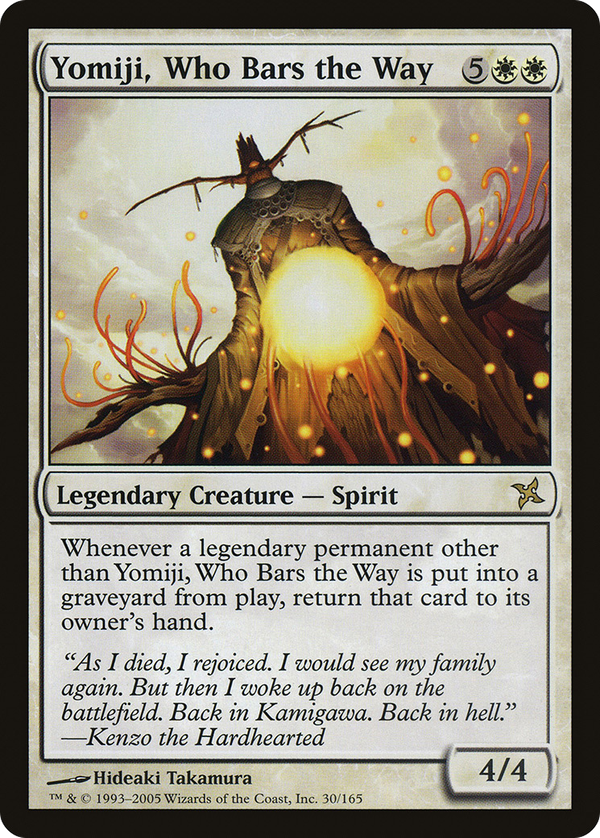
Yomiji, Who Bars the Way


The legend rule and the graveyard, locked in a feedback loop. In an early era, the legend rule was brutal: two copies of the same legend on the battlefield meant both were destroyed, a head-on collision that left the graveyard richer and both players poorer. This Spirit turned that built-in fragility into an engine, returning any legendary permanent other than itself that hit a graveyard from play, yours or an opponent's, to its owner's hand instead of leaving it dead. The design reads as a counter to a problem the game later softened on its own. When the rule was rewritten so a player simply keeps one of their own copies and sends the duplicate away, that particular self-inflicted bloodbath stopped happening, and the card kept doing its work on whatever legends still died: a recursion blanket draped over an entire permanent type. What it rewards is density. A board built on legendary creatures, artifacts, enchantments, and lands turns removal into a delay and a sacrifice outlet into a way to reload your hand from the yard. The 4/4 body for seven mana is the toll, not the point; the value is in refusing to let your singletons stay dead. Few cards treat "legendary" itself as a resource axis rather than a deckbuilding tax, and because the trigger is symmetrical, an opponent's legendary toolbox keeps coming back too. That symmetry complicates the proposition: you are protecting both sides of the table, and the deck has to be built to win the resulting exchange.