Xiahou Dun, the One-Eyed


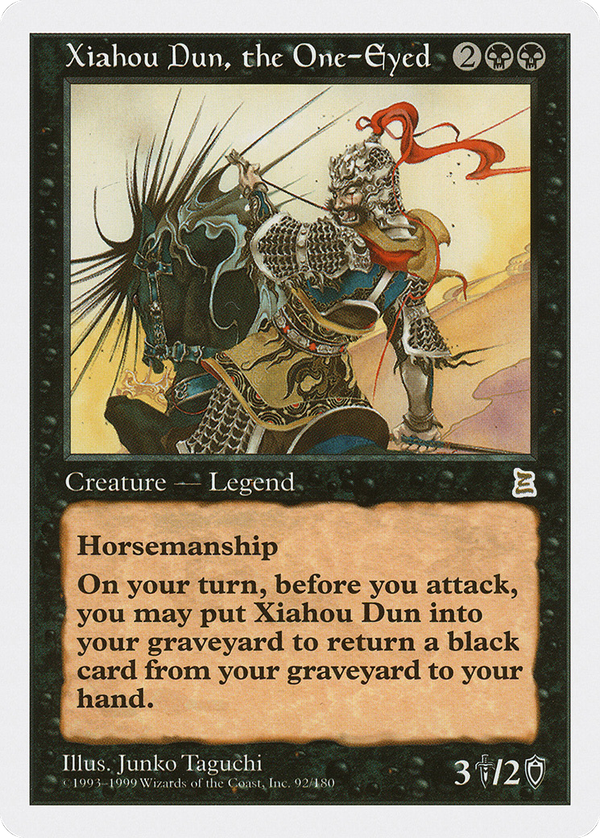
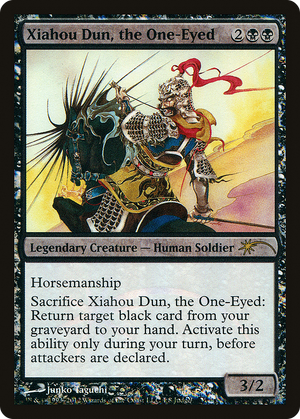
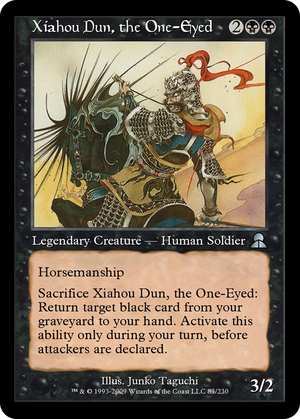
The activation window is the whole tension. You can only sacrifice this to recur a black card during your own turn, before attackers are declared, which forces a binding choice every combat: keep a 3/2 that walks past everything without horsemanship, or cash the body in to buy back a card and forfeit that pressure. There is no flashing the ability back during an opponent's turn, no holding it open as insurance, no second activation; the sacrifice clause makes this a one-shot conversion rather than an engine, and the timing restriction is what keeps a Regrowth attached to an evasive attacker from being oppressive. The asymmetry of that trade is what survives across formats: you are turning an evasive threat into card advantage, and the price of the conversion is the threat itself. Returning any black card (a removal spell, a discarded bomb, a second recursion piece) gives the effect a flexibility single-target recursion rarely has, but you spend the creature to get there and you only get to do it once. Horsemanship, the near-unblockable keyword native to this corner of the game, sits in the same lineage as fear and later evasion mechanics: almost nothing on the other side of the table carries it, so the attack lands far more often than it doesn't. The design pairs an evasive clock with a one-time graveyard reach, and asks you to decide, turn by turn, which one you need more.