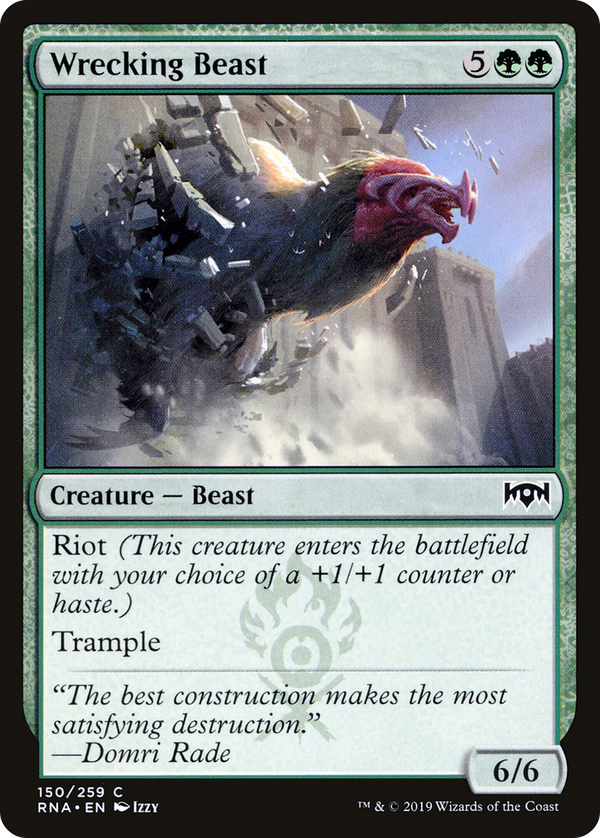
Wrecking Beast


Riot poses the same question at every point on the curve: do you want the body bigger or the body sooner? At two mana the answer is close, at three or four it starts to matter, and here at the top of the curve the choice sharpens into two very different threats. Take the haste and a 6/6 trampler attacks immediately, a seven-mana gamble that skips the summoning-sick window and forces a block or a chunk of damage on the spot. Take the counter and you get a 7/7 trampler that survives more of what green wants to survive, patient rather than explosive. The trample is what makes both modes count: chump blocks leak, and a haste attacker that would otherwise stall against a single token pushes damage through regardless. Riot's design elegance is that it never needs a scaling clause; the same keyword reads differently depending on where you slot it, and at seven mana it functions as a built-in read of the board state, letting the caster answer whether they are ahead (haste, close it out) or grinding (counter, out-size the ground). That the choice is made on resolution rather than in deckbuilding is the whole point: the flexibility lives in the moment of casting, not the list.