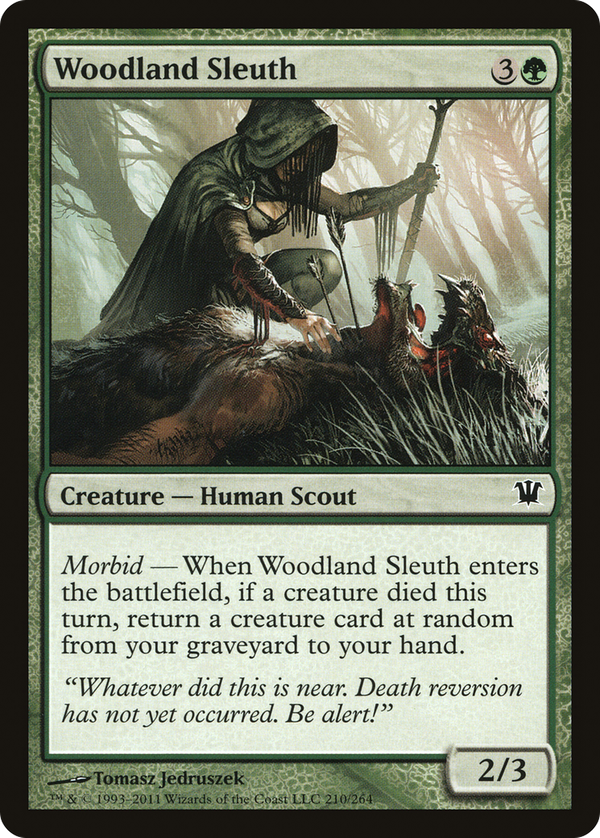
Woodland Sleuth


The morbid clause is the whole gating mechanism, and the random return is what tells you how this card was costed. Recursion in green has usually been deterministic: you pick the creature you want back. Here the condition is cheap to meet (any creature died this turn, including the chump you traded into combat before casting it), but the payoff is deliberately fuzzy. Returning a creature at random from the graveyard means the engine rewards a board that's been grinding rather than a hand that's been hoarding, and it prices the value down precisely because you can't snipe your bomb back on demand. The 2/3 body points to where this was built to live: the middle of a grindy aggressive curve rather than the top of it, a blocker that holds the ground while it quietly refills, in a color and an era where attrition through bodies was the plan. The randomness is the design discipline. A deterministic version at this rate would be a toolbox staple; the random clause keeps it honest as a value creature for decks already trading early, where any returned body is upside and the specific one matters less than the fact that the graveyard is feeding the hand at all.