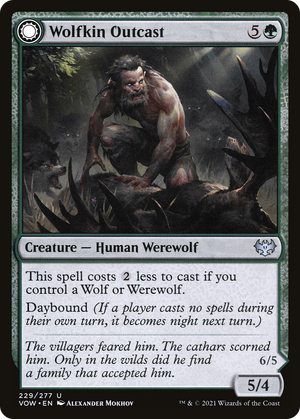
Wolfkin Outcast // Wedding Crasher
The werewolf mechanic's recurring design problem is that the transformation is the payoff, so the front face tends to be a weak placeholder you tolerate while waiting for night. This card answers that by making the front face pay for itself: the cost reduction means that once you already control a Wolf or Werewolf, the 5/4 body arrives ahead of its printed six, and the reduction leans on exactly the board state a werewolf deck wants to have anyway. That resolves the tension neatly, but the real design work is on the back. Daybound and Nightbound tie transformation to spell-casting tempo rather than a hard turn count, so the werewolf's flip is now a lever the whole table pulls, and the death-draw trigger turns the tribe's own attrition into fuel. Every Wolf or Werewolf that trades in combat, gets sacrificed, or falls to removal replaces itself, which reframes the archetype's fragile early creatures as expendable rather than precious. That is a meaningful shift for a tribe that historically wanted its bodies to survive to night; here, dying is part of the plan. The card sits at the point where werewolves stopped being a slow beatdown deck praying for uninterrupted transformation and started functioning as a grindy value engine that is happy to lose creatures on purpose.
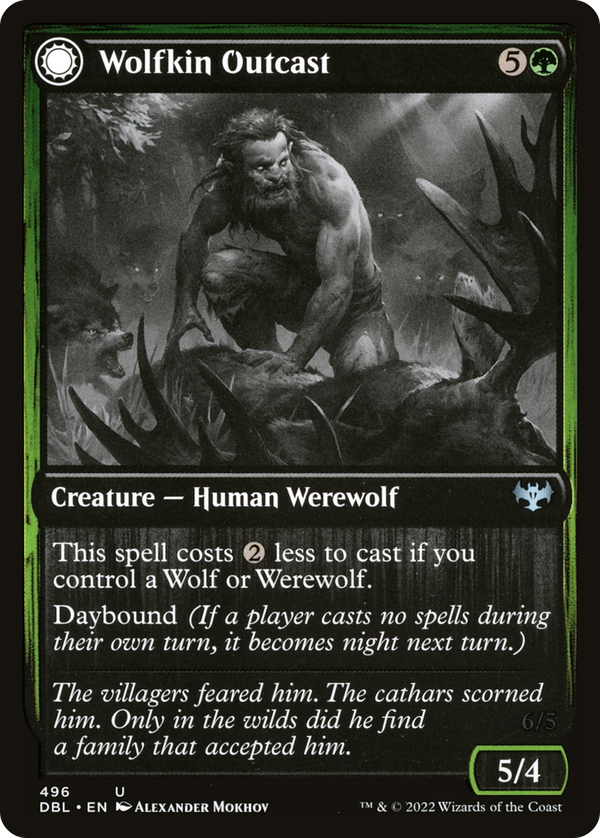
Rules text
 less to cast if you control a Wolf or Werewolf.
Daybound (If a player casts no spells during their own turn, it becomes night next turn.)
//
Whenever this creature or another Wolf or Werewolf you control dies, draw a card.
Nightbound (If a player casts at least two spells during their own turn, it becomes day next turn.)
less to cast if you control a Wolf or Werewolf.
Daybound (If a player casts no spells during their own turn, it becomes night next turn.)
//
Whenever this creature or another Wolf or Werewolf you control dies, draw a card.
Nightbound (If a player casts at least two spells during their own turn, it becomes day next turn.)