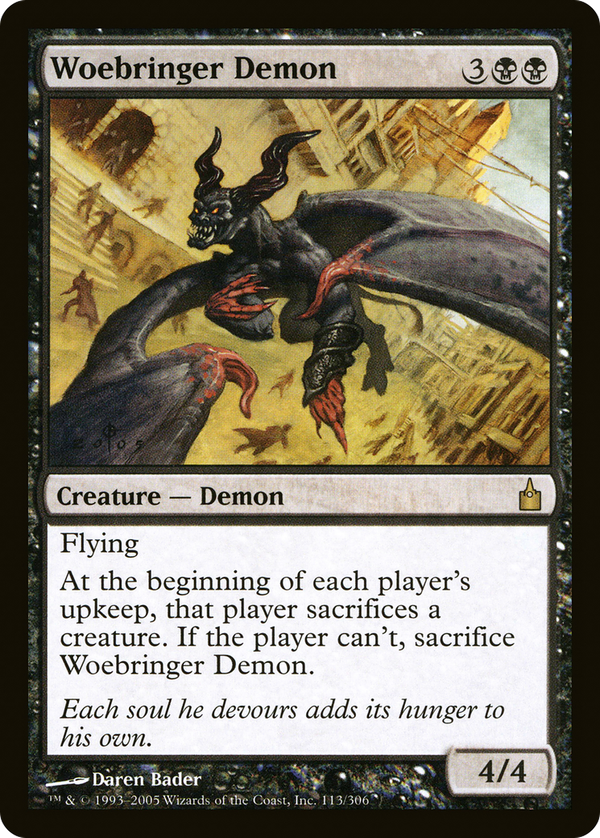
Woebringer Demon


The trap is the symmetry. Most edict effects fire at the opponent and leave the controller untouched; this one collects on every player's upkeep, the controller's included, and routes the choice through the sacrificing player rather than the demon's owner. That last detail is what bends the card from threat into liability. Against any opponent with bodies to spare, the edict simply trims their least valuable creature, and against tokens it does almost nothing while you keep feeding it real cards on your own upkeep. The escape hatch is the genuine danger: the moment a player has nothing to sacrifice, the demon eats itself, because the trigger names this creature specifically when no other body is available. So the upkeep tax is not something you grind across a stable board. It is a volatile clock that demands a board state you can rarely guarantee, which is why the 4/4 flyer matters more than the tax ever will. The evasive body is the actual win condition; the upkeep tariff is a cost you tolerate, and sometimes weaponize, never a payoff you build toward. The sharpest line runs through the self-destruct clause: against an empty opposing board, the demon will dutifully sacrifice itself, so reading whose upkeep arrives next becomes a real timing question. This is black creature design that taxes the whole table and trusts the controller's deck to absorb the cost, except here the tax has a habit of swallowing the taxman first.