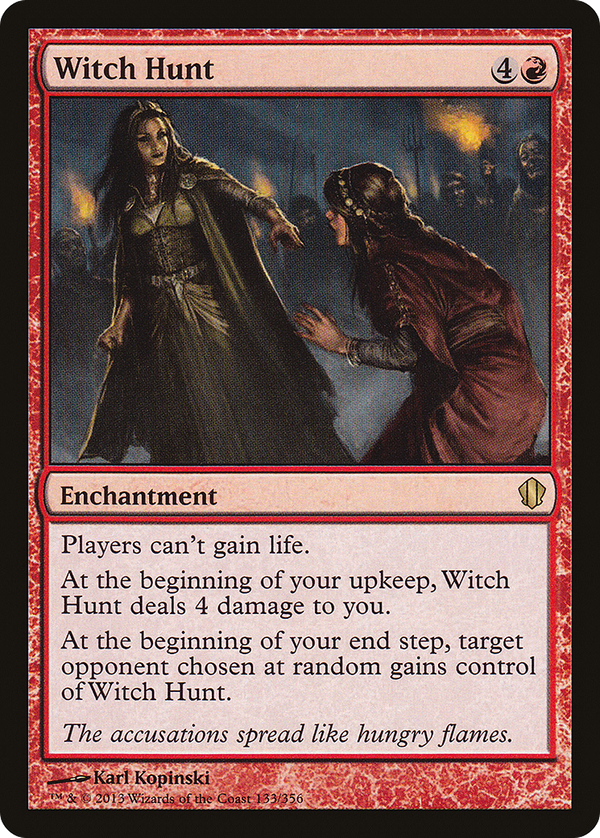
Witch Hunt


A hot potato dressed up as a group-table enchantment. The lifegain shutoff is the broad strokes everyone notices, but the design's personality lives in the two triggers that pull against each other: every turn it sits with you, your upkeep carves 4 off your total, and every end step shoves it onto a randomly chosen opponent. That randomness is the whole gambit. You cannot aim it, cannot guarantee the same target twice, cannot keep it parked on the player you most want bleeding. It is a clock nobody fully owns and nobody can plan around, which makes it less a removal piece than a chaos engine, the sort of multiplayer mischief that rewards a table already low and punishes whoever happens to hold it when the math runs out. The lifegain lock matters most precisely because it removes the obvious escape valve: the 4 compounds when no one can buy it back. As group-hug-turned-group-slug, it belongs to the lineage of symmetrical punishers that hurt their controller as much as anyone else, the difference being that control keeps moving rather than staying fixed on the one who cast it. You play it to accelerate an endgame, not to close one cleanly; it decides games by accident, which is exactly the point.