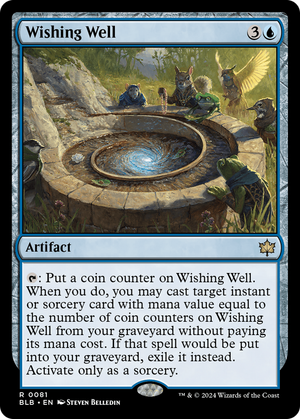
Wishing Well


The escalating counter is what makes this unlike any other graveyard recursion: each tap adds a coin counter and immediately offers a free recast of an instant or sorcery whose mana value exactly matches the current count, so the first activation wants a one-drop, the second a two-drop, and so on up the curve in lockstep. Most recursion lets you pick any target from the yard; this ties the recastable spell to a rising number you cannot skip past or rewind. Miss the matching mana value on a given tick and the activation does nothing; hit it, and the spell gets exiled after resolving rather than returning, so no single cheap spell feeds the machine forever. The sorcery-speed restriction closes off the obvious abuse of flashing something back on an opponent's turn, anchoring every free cast to your own main phase. Building around it is curve design applied to a graveyard rather than a hand: you want a spread of spells across consecutive mana values, so each new counter finds a live target waiting. It rewards a deliberately staircased spellbook and punishes clumping, a far more specific ask than "recur your best card." The name and coin-counter dressing lean into a slot-machine fantasy, but the play pattern is closer to climbing a ladder where every rung has to be built before you can stand on it.
Rules text
 : Put a coin counter on this artifact. When you do, you may cast target instant or sorcery card with mana value equal to the number of coin counters on this artifact from your graveyard without paying its mana cost. If that spell would be put into your graveyard, exile it instead. Activate only as a sorcery.