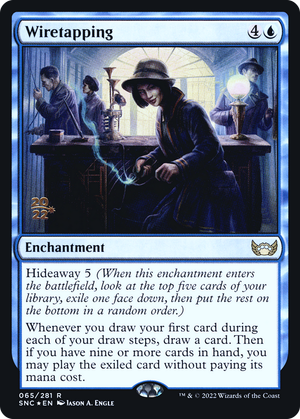
Wiretapping


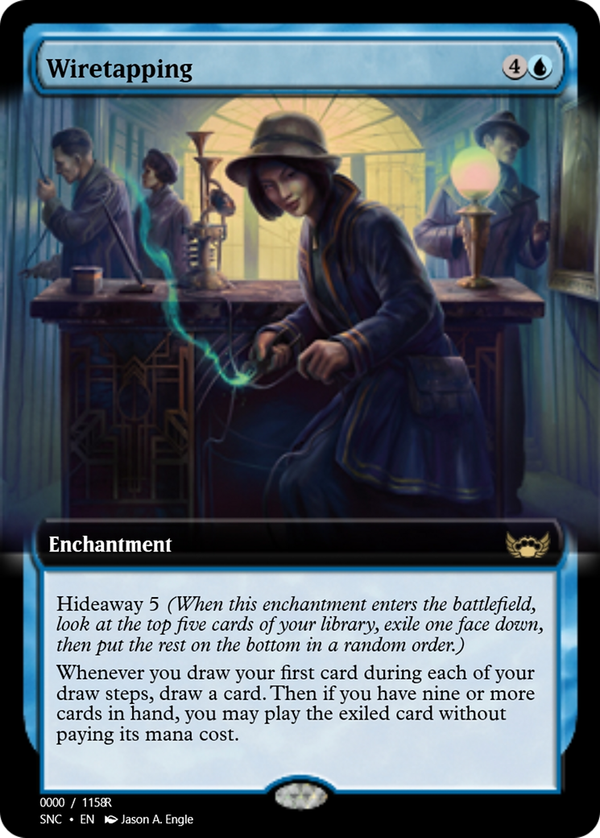
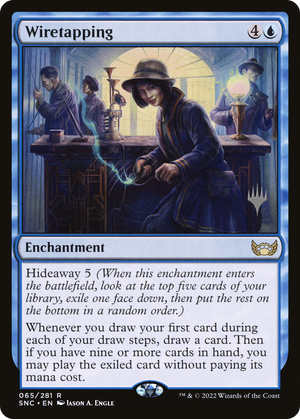
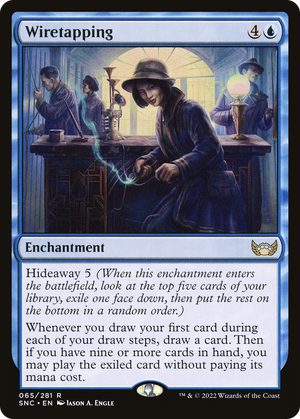
The tension every hideaway card wrestles with is the unlock condition: the mechanic buries a free spell under a clause that has to be satisfied before you ever see it, and most of the cycle chose gates tied to attacking, life totals, or board presence. This one reaches for the least combat-oriented threshold imaginable: hold nine cards. What makes the design cohere is that the enchantment enforcing that number is the same enchantment that gets you there, doubling your first draw each turn so your hand swells toward the ceiling under its own power. That makes it a self-feeding engine, but a slow and contingent one. Nine is a lot to reach and hold, and the payoff only checks at your draw step, so the exiled spell tends to arrive several turns behind the enchantment, if it ever arrives at all. The design is candid about its own pace: a durdle-forward value piece for the deck that would rather refill than deploy. Two details keep it functional even when the ceiling never comes online. The extra draw is unconditional, so the enchantment still reads as clean card advantage in games where the free spell stays exiled. And the free cast is optional, which matters because playing the exiled card sends it to the stack or the battlefield rather than back into your hand: crossing nine cards is a condition checked on resolution, not a resource you spend down by casting. This wants the patient blue deck that hoards cards on purpose and treats a fat hand as an asset rather than a liability.