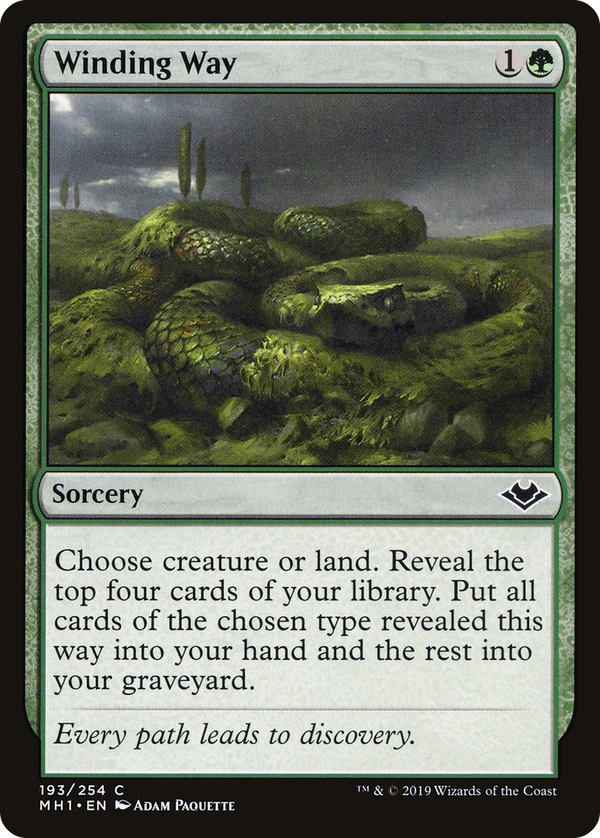
Winding Way


The clever part is the graveyard clause, not the card draw. Green has always had cheap card advantage tied to creatures or lands, but here the cards you didn't choose don't get shuffled away or lost to the bottom: they hit the graveyard, where green has quietly grown more and more able to use them. Choosing "land" and pitching creatures stocks a delve payoff, a self-mill engine, or a reanimation target; choosing "creature" and dumping the excess lands feeds the same graveyard from the other direction while keeping your bodies. The mode you pick is a bet on the top four cards you can't see, and the reveal makes it a public bet, which is a real cost against opponents who can respond to information. The rate is deliberately unimpressive on paper: two mana for an average of two cards is worse than a straight two-card draw, and the variance can leave you holding one. That gap is the price of stocking the graveyard, and stocking the graveyard is the point of the card. It rewards decks built lopsided toward one type, where the "wrong" pile isn't a whiff but fuel, and punishes the generic midrange pile that wants a clean two-for-one and gets a coin flip instead. A dig spell that treats your library's top as raw material to be sorted, with half of it always going somewhere useful rather than nowhere.