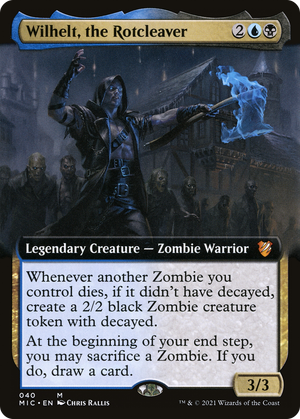
Wilhelt, the Rotcleaver



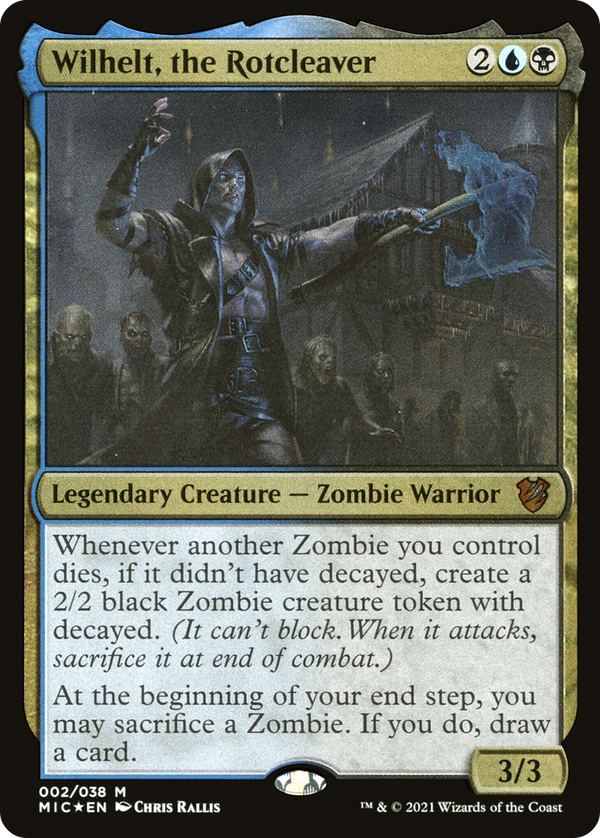
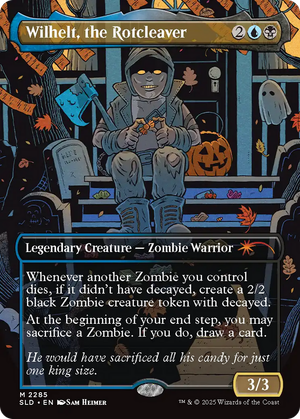
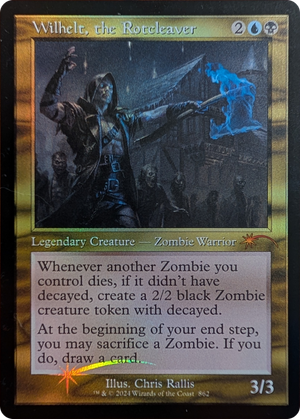
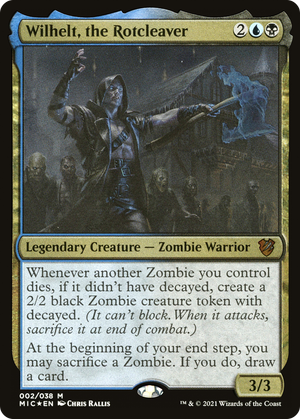
The decayed token is the trick that makes this a self-feeding loop rather than a static anthem. Every non-decayed Zombie you control that dies makes a 2/2 with decayed; that decayed token, when it dies, does not replace itself, so the engine has a built-in throttle that keeps it from generating infinite bodies on its own. The card's real design lives in how the two abilities feed each other across a single end step. Sacrifice a non-decayed Zombie to the end-step ability: it resolves, drawing you the card, and only then does the death trigger from the first ability go on the stack and mint a fresh decayed token. So one sacrifice becomes a card plus a replacement body; feed that token next turn, and you get another card. That cadence, one card per turn from a self-refilling pair, is why this legend became a fixture of blue-black Zombie decks the moment it appeared. The 3/3 body is almost incidental; the value comes from the chain of triggers, not from combat. Older Zombie payoffs leaned on flat lord effects or one-shot reanimation, so a legend that converts the tribe's inherent expendability into steady card advantage was a genuine reframing of what the deck wanted from it: not a bigger board, but a grinding engine that turns dead Zombies into fuel.